Greek life, Travels

Santorini

Erin, my sister, arrived last Thursday for a two week visit that is going way too fast. Earlier this week we flew to Santorini, probably the most well-known island at the southernmost end of the Cyclades. Volcanic activity (massive eruptions every 20,000 years) began 1.5 million years ago; today the crater of the volcano is located under the sea.

The last eruption in the 17th century BC destroyed the flourishing city of Akrotiri. It appears the city was abandoned pre-eruption so the citizens must have had some warning of what was coming. Like Pompei, the volcanic material that covered the city has provided excellent protection from prehistoric times until now.

It is estimated that only 3% of the city has been excavated (3% of 20 hectacres, that is), and what has been explored is likely the city center, as evidenced by the density of the buildings, the paved streets, an extensive sewer network connected to the sanitary features in the houses (yep, indoor toilets in 1700 BC) and the outside animal stables. More evidence of Akrotiri’s sophisticated society are the many frescoes and paintings in the residential section of the city’s multi-story buildings. The paintings prove some commercial exchange with Syria and Egypt; and also with the Minoan settlements on Crete, 60 miles south and visible on a clear day.

Akrotiri is beyond impressive. There have been legends for years that Akrotiri is the lost city of Atlantis, but it’s never been proven. Artifacts from Akrotiri are housed in the Museum of Prehsitoric Thira on Santorini and in the National Archaeological Museum in Athens.

When Demetri and I visited Santorini in 2006, Akrotiri was closed because of a roof collapse and replacement.  Today, the site is housed with one roof; it provides ventilation and natural light and its inside temperatures allow tourists and archaeologists comfort even in the heat of the summer. The site has no energy-consuming mechanical support.

Santorini’s rich volcanic soil makes for excellent crops of tomatoes, fava beans and grapes.  Santorini wine was famous in ancient times all over the Mediterranean and remains a successful export even today.  Most of the grapes grown are white (assyrtiko is the most prolific), but there are a couple of varieties of red wines that are gaining popularity.  The island also has unique, cool beaches — red sand, black sand, plain ole tan sand and lots of rocks from which to jump.

Weather for us was excellent: sunny, mid-60s. We explored the whole island on foot and by car.  The villages of Thira, Firostefani, Imerovigli and Oia all sit cliffside on the caldera with fantastic views of the volcano and the famous Santorini sunsets.  Even though it’s off-season, the island was busy with tourists. All the locals were busy prepping and primping for the summer crowds — the smell of fresh paint was everywhere.

Our trip to Santorini was actually the second trip Erin and I had. Her first weekend, we ferried to Hydra for one night that turned to two because high winds prevented the hydrofoils from running. An extra night in pretty little Hydra is an unexpected gift — we were able to visit the Archives museum and learn a lot about the role that Hydra and its citizens played in the Greek war of independence. It was a great introduction to the national Independence Day holiday on March 25.
 

Travels

Madrid

I could totally live here.

Which is clearly the opinion of 4 million others, since that’s about the current population. Madrid has many cool neighborhoods, beautiful architecture, gorgeous museums, parks, and is extremely pedestrian friendly. Cars actually come to a complete stop if you are near a crosswalk — a welcome change from the Athens madness. I rode the subway once at night, but really walking the city is better and it’s very safe. The sun doesn’t set until after 6 which is great, but it’s not light in the morning until 8:30 this time of year. Madrid is also the highest (elevation) European capital at 2200 feet, so the overnight temperature swings are closer to Colorado than Athens … so I wasn’t psyched to run in the dark or at 35 degrees.

Our dear friend and former babysitter and nanny Sydney, lived here for a year and gave me the Madrid insider’s guide. I visited the Prado Museum (300+ years of the King’s art collection – it’s huge and varied and so impressive), the Thyssen (with a great special exhibit of Picasso and Lautrec in its last 2 days) and the Reina Sofia (20th century art). Velasquez, Goya, El Greco, Picasso, Dali, Miro … and many more I hadn’t heard of. I also toured the cathedral and Royal Palace and — coolest — the royal kitchen, which takes up half of the enormous palace basement and has most of its original 18th century items in tact. It was amazing.

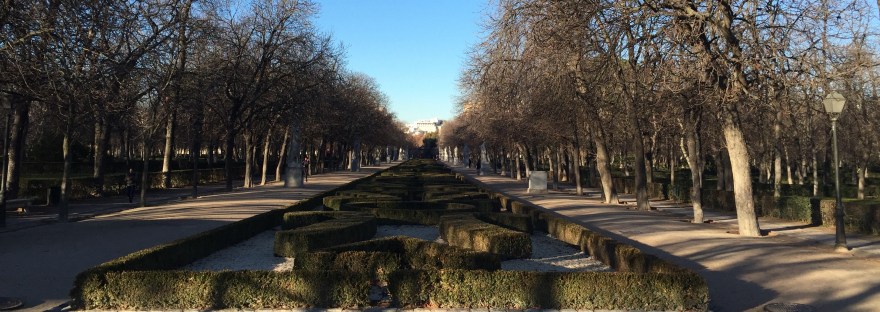
I walked around and through the El Retiro Park, which was transformed from the royal garden to a public park by Charles III in the 1700s. I walked to and around lots of neighborhoods – Lavapies, Salamanca, Malasana, La Latina and spent most of a day between Puerta del Sol and the Palace. We were here for a day in 2011 on a layover on our way to Greece. Michael was not yet 2 and didn’t sleep much on the red eye. We were so tired I remember being dizzy. But as I walked through the Plaza de Oriente, I recognized it as the park where we played and saw the cafe where we sucked down a coffee (two?) in 2011 while Michael passed out in the backpack carrier. He had a lot of ill-located naps on that trip.

I went to Madrid solo. I obsessively tracked my steps and mileage: 35 miles/82,000 steps in 72 hours. I missed Demetri and the kids – I haven’t been separated from the little guys for more than an evening since we left Denver. I’m not sure they missed me, though. They were doing nightly gyro comparisons in the square (K.Grill has crispier, grilled pita and serves more tzaziki, Gnision’s meat is more flavorful and the pita is warm and soft, Masati has crispy meat.  Winner: Gnision.) And when I called home and asked Michael what they were doing, he said “whatever we WANT! It’s boys’ time!”


Travels

Winter holiday numbers

  • 6 cities
  • 2 countries
  • 40-ish cappuccinos (too jittery to count upwards of 10)
  • 13 churches
  • 1 ancient city covered in volcanic ash
  • 5 trains
  • 2 funiculars
  • A few subways
  • 3 trams
  • 5 buses
  • 10 scoops of gelato
  • Countless noodles
  • 3 articles of lost clothing
  • One elf on the shelf
  • 12 exploratory morning runs
  • 3 bottles of cough syrup
  • 2 packages of ibuprofen
  • One puke
  • 236,500 steps
  • 111 miles walked/run/chased/raced
Travels

Rome

A million people lived in ancient Rome. That’s the same number of people living in San Jose, California today.  The famous Roman myth establishes the city in 753 BC, when Romulus killed his brother Remus and gave the city his name.  In 509 BC, the city eliminated the monarchy and established a Republic. Fast forward through the second century and the triumvirate, to 27 BC when Augustus Caesar becomes the first Roman Emperor. Until it began to disintegrate in the 5th Century AD, the Roman Empire was the most sophisticated society in the western world. It’s (Constantine the Great’s) creation of Constantinople had a profound effect on Europe, as it was the defense against invasion and conquest from the East for close to 1000 years.

We took a taxi from the train station to our apartment, and our driver took us through Piazza Venetia and past the Italian Parliament building and the spindly Christmas tree that has become a national embarrassment – Romans were outraged in December over its droopy branches and general dowdy appearance, and have nicknamed it “the Mangy one.”  They got even madder when it came out that the city council paid 48,000 euros ($60K) to have it brought to Rome from the northern mountains. But maybe it grew on them a little — earlier in the week, there was to be a decision on the next life of the tree: put it in a museum, make pencils for all the school children or make a shelter for women to feed and change their babies.  A press conference is to announce the decision.

We stayed in a beautiful, sunny, modern apartment right near the Colosseum, where we had views of parts of the ancient forum and the arch of Constantine, one of my favorite structures from a college Roman art & architecture class.

We had a couple of hours of daylight left when we arrived, so we dropped our bags and hopped the city bus to the Pantheon before it closed.  From there we walked to Campo dei Fiore and had dinner at a terrific Osteria, sampling amatriciana (tomato sauce with fried pork cheek; tastes like bacon), cacio e pepe (cheese and pepper), fiori de zucca (zucchini flowers stuffed with cheese and fried), and bruschetta.  The traditional noodle in Rome is spaghetti.  From there we walked to Piazza Navonna, which was surprisingly uncrowded and still had some of its Christmas market set up.  We played games and won prizes and took lots of photos in the Piazza before grabbing some gelato, hopping back on the bus and crashing in our apartment.

Demetri went for a very cool run the next morning through the forum, under the arch of Constantine, and over to Circus Maximus.  Tyler and I have nasty colds and tuberculosis-like coughs so we stayed home with the little guys and we all slept until almost 9.

Day 2 we toured the Colosseum. Originally known as the Flavian Amphitheater, the Colosseum held 50,000 – 80,000 people.  It was commissioned by Vespasian in AD 72, then completed by Titus and later improved by Diocletian.  Vespasian ordered the Colosseum to be built on the site of Nero’s palace, the Domus Aurea, to try to erase the memory of Rome’s most feared tyrant.  The name likely came from the Colossus of Nero (a statue based on the Colossus of Rhodes where Nero was depicted as the Sun God) found nearby.  Vespasian’s goal was to gain popularity by staging fights of gladiators and wild animals for public entertainment.  At the first games, some 9,000 animals were killed. Animals from Africa were often brought in for the games: lions, giraffes, hippos, rhinos, ostriches and there was a very complex caging and entry system for the animals.  Roman gladiators were usually slaves, war prisoners or criminals. Most were men.

There were different sections for the various demographics — the senators, rich men, poor men, and poor women (rich women were allowed to sit with their husbands in the good seats).  We learned that ‘arena’ is the Latin word for sand, which they needed a lot of during the games because blood is so very slippery, of course.  When the floor got too bloody, they would cover it with another thick layer of sand and continue on.  The boys’ eyes got very wide when our guide explained this.

We left the Colosseum and picked up some sandwiches, then hopped the bus again to the gardens (a huge park, really) at Villa Borghese.  We had a picnic there, and then walked and played in this park, which was turned from a vineyard to an extensive garden by Cardinal Borghese in 1605.  Borghese was nephew to the pope and the patron of Bernini. In the 19th century, the gardens were renovated in the English style. The Spanish steps lead up to this park. The weather was the best in Rome — Sunny and 60 degrees for our entire visit.  It was great to enjoy some sunshine.

That night we had dinner in a little restaurant near our hotel with a one man chef and waiter who kept bringing us little gifts — like bruschetta and meatballs.  His food was great.  We walked a bit, found some gelato and came home.

Saturday was our last day and we had about 4 hours to sightsee. We went over to the Trastevere neighborhood and walked through the streets there, along the Tiber River, on the backside of the Vatican, past Castel Sant’ Angelo and into Piazza Cavour, one of the nicest, greenest European squares we’ve seen.  It’s name for the Count of Cavour, a statesman who helped lead the movement for Italian unification.  Romans don’t like the palace of justice (supreme court building) that flanks one side of it –they say too gaudy — but it’s a grand, magnificent building.

Saturday was January 6, the feast of the Epiphany, a big holiday in Italy. The piazzas were packed; buses even more so.  We hopped a bus back to our apartment where we were wedged between people and had to hold our breath.  The bus came around a corner and hit a car that was double parked.  While the bus driver and the car’s owner yelled at each other for a while, we got off the bus and high tailed it to the next bus stop, got back on, got our bags and to the airport with a little time to spare.

Demetri did all the logistics for this trip and he nailed it with every place we stayed.  He chose apartments that were typical (or classic) to the city we were in and they were all special and beautiful in very different ways.  We really love train travel, it’s so easy and so reliable and so darn comfortable.

We’re back in Athens, back in school (all 4 of us) and almost have the laundry caught up. And we have Tyler until Friday.

Travels

Naples

Naples: home of Elena Ferrante and her Neapolitan novel series, limoncello, bufala mozzarella, and sfogliatelle, which is as fun to eat as it is to say. Well, actually it’s kind of messy but it’s delicious nonetheless.

We stayed in an 18th century apartment in a 4 story building that was originally a family home in the historic center of Naples.  It is decorated in 18th century style and the ceilings must be 20 feet tall.  Our street, via dei Tribunali, was the main east west street of the ancient, thriving Greek and Roman city of Neapolis. We were blocks from the best Neapolitan pizzerias in town and just down from the Duomo di Napoli.  Naples had great wealth from the ancient times until Italian unification, but after it joined the united Italy in the late 1800s, its wealth was used to fund industrial expansion in the north, so the city lost its glamour. It was also the most bombed Italian city in World War II, as Naples was the first Italian city to rise up against German occupation.

The city has a scrappy feel (my man Rick Steves calls it a ‘tangled mess’) compared to other Italian cities, maybe thanks to influence from the Camorra, Naples’ mafia, which is the oldest crime organization in the country, dating back to the 17th century. It has lots of pretty areas and charm once you get used to the noise, the brazen scooters and the alley-like streets.

Our first day we walked the city, starting at the top rated sfogliatelle bakery, then taking funiculars from the old center to various points around town, ending the day along the water and through the Piazza del Plebiscito where the lights on the church reminded us of Denver’s civic center building. We stopped for dinner at an antique pizzeria where a popular, famous pizza was invented and named for Queen Margherita di Savoia. (The margherita pizza, of course.)

We spent our second day in Pompeii, the ancient Roman town that was destroyed in 79 AD when Mount Vesuvius erupted and buried the area under 15-20 feet of volcanic ash.  The site was unknown for some 1500 years until the mid 1750s.  The town and the objects found in it have been perfectly preserved because of the lack of air and moisture – and the artifacts gave historians detailed information and insight into life in an ancient Roman city. Walking through the ruins, you immediately notice how organized and efficient the city was planned out: market in the center, villas on one side, smaller houses on the other.  Public areas close to the center, an amphitheater, roads for chariots and sewer waste.  During excavation, plaster was used to fill in the spaces of the ash layers that once held human bodies, so archaeologists could see the exact position the people were in when they died. It was fascinating.

It was dark when we left Pompeii.  From there we continued on the train to Sorrento, home of the famous lemons that make limoncello. It’s a beautiful area of Italy, with the Amalfi coast just to the east and the island of Capri right offshore.  The buildings that stack from the top of the city down to the water gives it a cool dramatic look from the bottom. The holiday decorations were beautiful and the main square is really pretty. We had a quick dinner in Sorrento before boarding the train back to Naples that night.  And from here, naturally, all roads lead to Rome.

Oh, and the cover picture on this page is a nativity scene made entirely of pizza.