

The island of Evia, or Euboea as it’s transliterated, has been on Demetri’s exploration list for some time. It’s Greece’s second largest island, full of mountains, trees and even a few hot springs. It’s easy to get to from Athens, too — a bridge connects the Attica peninsula to the island, and there are smaller ferries that you can take (with car) if you’re coming from elsewhere on the mainland. That’s what we did.
 We left Meteora and drove to the little town of Glyfa for a 19 euro (4 people plus car!), 20-minute shuttle ride to the small port of Agiokambos on Evia’s northwest side where we docked, watched some little boys fish with a spool of fishing line and a hook (no poles needed thank you very much!) and headed east to the village of Agia Anna. Demetri found a small, beautiful hotel right on the 7 km long Agkali Beach. Agkali looks to be of the best-known beaches on the island, but it felt private and secluded. The beach itself is known as a ‘pebble’ beach. They were more like rocks: the coolest, most beautiful mix of colors. Peter and I spent time two afternoons inspecting and collecting a bunch of different ones. The next day, Demetri found one that looked just like a human ear! Cue several “I-can’t-hear-you” jokes.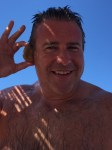
Demetri invited Papou and Sandy to join us there and one morning at breakfast, Papou strolled in at an amazingly early hour. The boys loved having him with us. Together, they shuttled from beach to pool, where Papou taught Peter to dive — really dive instead of belly flop. I think the kids had the best vacation of all: the hotel had a fantastic kids program with activities in their ‘magic forest’ all day long, games at the pool, soccer on the beach and movies at night. They would leave breakfast, we’d drag them away for lunch and some swimming mid-afternoon, and they’d come back so we could head into the village for dinner. Unless of course they were having dinner at the all-you-can-eat-souvlaki-or-pasta-with-fazolakia kids buffet. While the boys were playing soccer and capture the flag in the magic forest, Demetri and I sat on in shady chairs on the beautiful, isolated beach and watched the lone ferry that travels from Evia to the island of Skopelos across the water. Skopelos is in the Sporadic island group and is famous for being the film site of “Mamma Mia.”
You can’t really see it, but the photo above on the beach is a horse in the water. Across from the hotel is a little farm with roosters and horses. Kyria Nancy offered a little field trip to magic forest kids to feed and brush the horses, of which Peter took full advantage, and she also took groups riding on the beach. One day a group came by and the next thing we knew, one of the horses was swimming. It was astounding. The rider stayed on as the horse frolicked in the water. It was absolutely beautiful to watch.
 In terms of Greek history, Evia was the site of a famous battle with the Persians in 480 BC, at the exact same time that Leonidas and his 300 Spartans were fighting at Thermopylae. The battle on Evia is said to be a draw: a severe storm caused both the Greeks and Persians to cut their losses and skedaddle. Evia is also where the huge, famous statue of Poseidon was found by fishermen in the 1920s. The statue is a central piece today in the National Archaeological Museum.
We liked Evia so much that our three days turned to six. There was a great breeze so it didn’t feel too hot. We watched the World Cup finals in our pretty little room facing the sea, and we came home with good tans, magic forest crowns and fun paintings.
We’re back in Athens with the air conditioners getting quite a workout. We swam here one afternoon and the water was so warm it felt like a jacuzzi. Our last set of visitors arrive today and we’re starting to separate things to pack, purge, and give away. My mom sent photos of our yard this week and both kids are dreaming of barefoot soccer in the cool, soft grass.

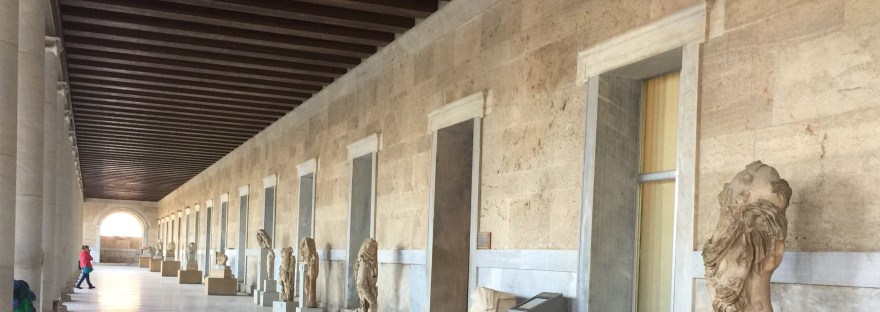
 The Temple of Hephaestus stands on the west side and is one of the best preserved monuments in the entire city. Hephaestus was the god of fire, but also the god and patron of metalworking, stone masonry and sculpture. He was the son of Zeus and Hera and was married to Aphrodite, though Aphrodite cheated on him with Ares. Hephaestus was the official blacksmith for the gods and made all the weapons for Olympus. Inside the temple were two bronze statues of Hephaestus and Athina. In the 7th century AD, the temple was converted to a church and in the 18th century, many prominent Athenians and statesmen were interred here.
 What is super interesting is to learn is that there is a perfect isosceles triangle between the temple at Sounio, the Parthenon and the Temple of Aphaia Athena on Aegina Island, which is visible from Cape Sounio. Mathematics were a very important part of ancient Athenian life — and geometry ruled the construction of the Parthenon — but this triangle proves that the location of various monuments was based on geometric shapes. How they figured out these points and distances is hard to imagine, but it sure is fascinating.
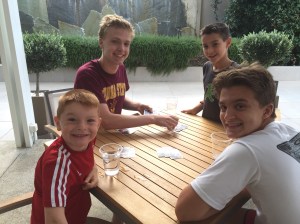 We left Sounio for a proper lunch in a traditional taverna in Vouliagmeni — lunch is always a good reason to wait out the rain. It was our last day together, after two full days in Athens and late nights for food. We spent the afternoon at the pool at their hotel, though the clouds and rain made it a little too cold to swim. Michael brought a deck of cards so there were a few rounds of go fish and crazy eights. I kidnapped Allison her final morning for a walk reminiscent of our single girl DC days when we’d trek from TC Williams high school down to Old Town Alexandria and back. They went onto Rome that afternoon.
 The Fefes Adventure Collective