
Lots of famous Greeks hail from the Mediterranean’s 5th largest island: writer/philosopher Nikos Kazantzakis, author of Zorba the Greek, painter Domenico Theotokopoulos (El Greco), Greece’s premier statesman Eleftherios Venizelos, King Minos, and of course Zorba himself.
Crete is a beautiful, fascinating place. We first visited in 2011, spending a week on the beach with a 20 month old Michael. It was the ten year anniversary of 9/11, which ended up being insignificant. However, Tripoli had just fallen to rebel fighters and Gadaffi was in hiding. The large NATO base on Crete had several fighter jets a day taking off and heading to Libya, a short 600 miles away. Little Michael was thrilled to have so much plane action while he played in the sand.
Crete separates the Aegean from the Sea of Libya. It was once the center of the Minoans, the earliest known civilization in Europe, who inhabited the island from about 2700 – 1400 BC. King Minos was its ancient king, who ruled from his palace at Knossos, the (amazingly preserved) ruins of which lie in the central northern coast of the island. Minos is most infamous for demanding Athenian youths to feed to the Minotaur in the Labyrinth. The Minotaur was half bull and half man, who met his end at the hands of Theseus. It has been questioned if Minos was a real person instead of a mythological character, but there’s no real conclusive evidence. “Minos” may have been a title like Caesar or Pharoah.
The Minoan civilization was discovered very recently — early 20th century. They had a large navy and established a great deal of trade throughout the Aegean into the Cyclades islands, Egypt, Cyprus and Anatolia. The civilization’s best art is preserved on Santorini before the volcano destroyed the island. The Minoan civilization declined between 1400 and 1100 BC when the Myceneans came into power and took over the Minoans sea-based empire.
What makes Crete so nifty, in our opinion, is that it has its own culture. It’s definitely Greek, but with an intensified spirit evidenced in its history and its food and drink. Just looking at the lists of famous Cretans tells you so. The Cretan resistance in World War II performed an astounding number of feats, including the capture of a German general from right in the center of the Nazi occupation. The famous Churchill quote, which goes something like, “we used to say Greeks fought like heroes, now let it be known that heroes fight like Greeks,” came from the Cretan warrior spirit known for generations, but shown to the modern world in the Second World War.
As an aside, if you’d like to learn more about the Cretan strength, endurance and nutrition, pick up a copy of Natural Born Heroes by Christopher McDougall.
In addition to its razor-sharp mountains and numerous gorges, Crete boasts some of the best beaches in the Mediterranean. In January, we planned a trip there with our dear friends and Denver neighbors, the Lundstroms. They arrived just as school ended in Athens and that night, we loaded 8 people and our car (packed with paddle boards and other beach equipment) onto the overnight ferry, arriving in Chania at 6 am on Saturday.
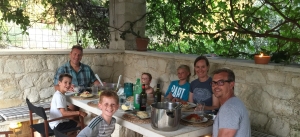 The owners of the house we rented were incredibly gracious and allowed us to check in (very) early: 7:30 am. They met us there with warm bougatsa, fresh fruit and a shot of raki. Raki is tough any time, but 7 am sends you to the moon. I don’t remember why we didn’t nap that day … but instead we picked up Russell’s rental car, shopped for groceries, played ping pong, swam in the pool and headed to the Chania harbor that evening. Chania is Crete’s second largest city. It’s a lovely town with old Venetian walls and a beautiful lighthouse in the harbor.
 We looked forward to their visit for months. Michael and Peter were thrilled to have friends from home and it was fun to see them pair off in different combinations for the week. Peter has always adored Max, the elder statesman of the kid group, and Sam and Michael are in the same grade and have an easy friendship. This time, Michael and Max spent time together talking about & watching the World Cup, and one day Sam and Peter hunted for all kinds of sea creatures. We had dog paddle races, surfed on the paddleboards on a windy afternoon, snorkled, boogie boarded, flossed, swam a lot and tried to make goats faint. Sam kept a list of all the different animals & creatures we saw. One day, Lundstroms went to Knossos to see the palace and Fefeses hiked in a small gorge. We got rained out; they didn’t … and were happy for the cloud cover. That night we enjoyed homemade spaghetti thanks to Russell and a bottle of red wine thanks to our sweet hosts.
The palace of Knossos was the largest of its time and was the seat of power for the Minoan civilization. The main building covered three acres and when you include the out-buildings, it totals five acres. The palace had bathrooms, a drainage system, an enormous center staircase, a cult ritual room, 16 storage rooms and a theater for 400.
 Sam had a great idea to try different beaches and then on our last day go back to our favorite one. In all, I think we did four different beaches in 6 days. Midweek, we caravaned over the mountains to Elafonisi beach, ranked in the top ten worldwide. Elafonisi has pink sand, black rocks, and bright blue shallow water. Demetri and Max nicknamed it “Gucci Beach” because it was so … fancy. We swam and boarded and snorkeled for hours. The beach we went back to was Stavros, famed for being the location shoot for Zorba the Greek, starring Anthony Quinn. We also swam at Marathi Beach and Loutraki Beach. We ate lots of souvlaki and watermelon and consumed our fair share of apricots, cherries, coffee, raki, Pringles and cold Greek beer. Demetri, Russell and Max had two sessions of “Death by Pushups” and “Death by Squats.” Apparently neither was as fun as it sounds.
Our week together went too fast but it was so awesome. We ferried back to Athens Groundhog-Day style, arriving again at 6 am. The kids played with the castles and knights on the patio until it was time for them to depart. I’m sure they arrived back in Germany with a lot of extra sand in their bag.


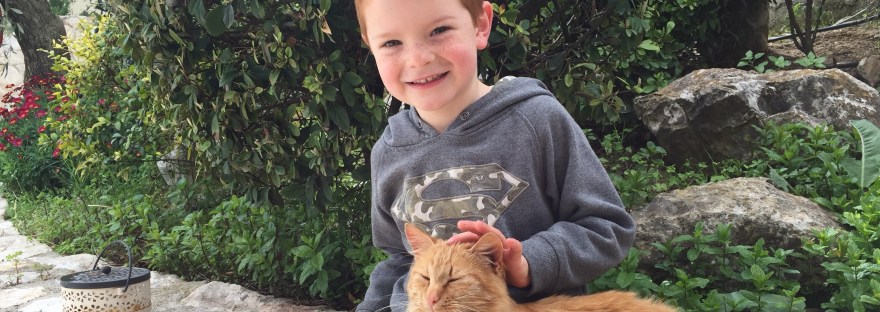

 The field trips with this unit were awesome. First, they went to a sea turtle refuge just down the road from our house and learned about how the refuge helps the turtles become healthy and able to go back into the sea. Our class adopted a χελωνα (turtle) named Nemo for a month, paying for all its medical needs and food. In April, they collected recyclable materials all month in the classroom and then loaded it onto the school buses headed toward a recycling center. The kids and staff talked there for more than an hour about how recycling is good for the earth … and the sea.
 Their final field trip was to the beach at Varkiza, where they picked up trash for a few hours. Kyria Anna told us that the area they cleaned had not one speck of trash when they left. Peter came home talking about all the kalamaki (straws) they found on the beach, and how his pal Demetri found a
  The Fefes Adventure Collective