
Greek life, Travels

Hydra

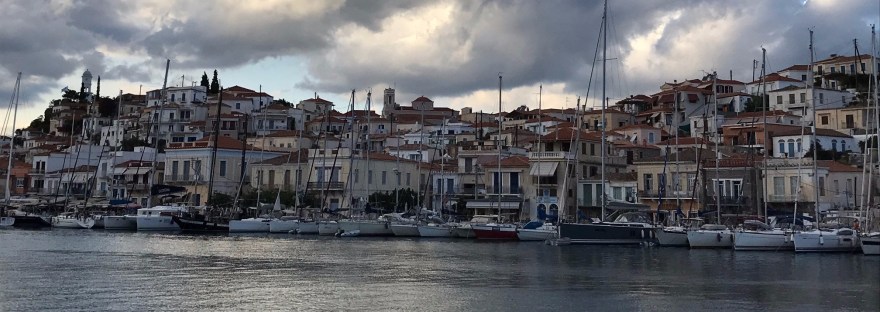
I read an article not long ago that referred to the island of Hydra (say “ee-dthra”) as ‘Greece’s Nantucket.’  No cars, taxis, scooters, motorcycles allowed; transportation is on foot or mule. It is f-u-l-l of cats.  Aside from a skid steer here or there for building renovations, the only vehicle on the island is the garbage truck.  The no-car rule has has kept heavy construction and development very low and makes Hydra feel remote and far from anything — even though the Peloponnese is just across a narrow strip of water. There are no resorts or other large hotels, just quaint little hotels and B&Bs, many of which are former mansions.

Hydra played a prominent role in the Greek War of Independence, which began in 1821. Several island residents, many of whom were naval officers, formed a secret revolution society and raised significant funds for the rebellion.  During the war, Hydra was the focal point of the Greek navy.  In 1830, after several years of fierce battles, England, France and Russia forced the Ottomans to recognize the Greek independent state.

We’d been planning to visit Hydra sometime in September, and finally made it last weekend. Summer is basically over, but the islands are still lovely enough to enjoy what we Coloradans call ‘shoulder season.’ Demetri has been here three times: once as a kid, once in 2010 with Tyler and last weekend with us.  Hydra summers are super hot; relief comes from a high jump off a huge rock into the turquoise water below.

We stayed in a sweet little hotel near the harbor, where the owners made breakfast for us each morning: omelettes, crepes, yogurt, fresh bread and homemade peach marmalade. We had dinners in little tavernas situated beneath bougainvillea and Sunday lunch in a ψσαροταβερνα (psarotaverna – fish tavern) overlooking the ocean.  There was a large family table next to us with three guitar players and they had much of the restaurant singing along.

The patron saint of the island is St. Konstantinos, an 18th century saint who was born on Hydra but spent much of his life in Rhodes, not knowing that been secretly converted to Islam and and had his name changed by the Turks. We hiked up to the church and monastery named for him on our way up to another monastery at the top of the mountain.  Thanks to increasing ecotourism, many towns, islands and villages throughout Greece have revived the (very) old goat herder trails and marked them for hiking and walking.  The paths take you through forests, over mountains, into valleys, and now since they’re marked, you can be confident instead of hopeful that you’ll make it to your destination and back.

We followed the square yellow tags to the monstery of Profitis Ilias — three steep miles uphill with spectacular views the whole way. We met a nice couple from Brooklyn about halfway up and walked with them for a bit.  Michael, our little mountain goat, seems to get more energy with every step no matter where we are hiking. He zipped up the mountain, smoking the rest of us per usual. Peter won the trooper award that day, walking the whole thing and never once asking to be carried.

At the top, Demetri explained to the boys that the priests who live here have a very quiet life of service and we needed to be respectful and quiet also, maybe even silent, as the men who lived here most likely never speak. At that moment, a priest came through the gate wearing a fleece jacket, new Nikes and talking on his smart phone.

While Demetri and Michael walked into the church and lit a candle for Uncle Michael, Peter and I stood outside to look at the mules who had shuttled some folks up the hill. Peter turned to me, pointed to the priest with the smart phone, and said, “that man looks exactly like the god in my brain. His hat, and his beard and his clothes are exactly the same.  How about the god in your brain, mommy?  What does he or she look like?”

I was speechless.  I stared at him for a few seconds before answering his question. I am constantly awed by how children’s brains work — so innocent, so genuine, so logical that as the adults we can see how the thought started and how their question or comment formed. This thoughtful rumination from a five year old tops the list maybe forever. I had to write it here so I never forget it.

We left on the 4:45 ferry Sunday; Papou was standing at the dock in open-arm hug stance to take us home. When he asked the boys what they liked best, they talked about the 4 kittens we met living under a house they named Fluffy, Sweetie, Patches and Orange Julius (Demetri’s hilarious contribution.)  Hydra is a must see.  Even though Monday morning came fast and early, Michael said the weekend was nice and long.  That’s just how you want to feel when you’re climbing out of bed to start the week.


Greek life

Car saga, continued

Our prediction of a paperwork problem with the car came true.  Demetri got a call from the dealer one morning this week telling him his name can’t be on the title unless we pay an “Expediter” €125 to handle this under the table.  In other words, our national visa issued by the Greek government is inadequate for a car title, we must have a green card.  But with the  €125 ‘fee’ (known locally as fakelaki), we can have the car in our name.

This is not our first experience with the fakelaki issue.  We bought two Stand Up Paddleboards before we left the US and had them shipped to Athens.  When Papou went to retrieve them before we arrived, he was told there was a €500 fee to get them out of customs. 500 euros is almost the cost of one SUP. Surely they were joking.  Papou did not pay; the boards were safely stored until we arrived and could straighten out this silliness.

Turns out the silliness was ours. Let me back up: Fakelaki translates to “little envelope.”  It is the term for bribery of government or private companies by Greek citizens to ‘expedite’ service.  I’ve heard it compared to a gratuity (e.g., slipping a  $20 to the maitre d’ to get moved to the top of a wait list at your favorite trendy restaurant), but it can also mean a specific tariff demanded by government officials in order to bypass procedure.  The dealership manager explained that the Greek system is so bloated, the fakelaki ‘greases the wheels’ to move things along.  

Back in July, if we wanted the SUPs, we had to pay the fakelaki.  Simple as that.  And, it had to be cash.  So, we’re paying it because Customs told us we had to, yet the cash never made it to the government.  There was no paperwork or receipt.  The same was true for the car title.  While it sounded very official, when Demetri tried to pay the €125 by credit card, the dealership manager said, “Signomi, sir, cash only.”   The conversation ensued as follows:

Demetri: “So, I won’t have legal title if I don’t pay the expediter? And in this case, YOU are the expediter?”

Dealership manager: “Right and yes.”

Demetri: “But the title will be legal if I pay this cash fakelaki?”

Dealership manager: “Yes.”

Demetri: “And what happens if someone does a search for the title? Whose name will it be in?”

Dealership manager: “The database will return a result that says the title is ‘lost in the ministry.'”

Demetri: “And that is a legal answer?”

Dealership manager: “Yes.”

Demetri: “What happens when I sell the car?”

Dealership manager: “The title search result will say ‘lost in the ministry’ and someone else will be able to buy the car. Kanena provlima (no problem).”

Demetri: “Ok. So, I have this cash, do I need an actual envelope?”

Dealership manager: “No, you can just hand it to me.”

This car dealership is the European equivalent of CarMax in the US.  It’s headquartered in Austria.  It’s financial center is in Brussels.  The car was shipped from France. This isn’t some dude in his garage selling stolen cars to fuel his drug habit. This is standard procedure in Greece for a multi-national European company.

I agonized over how to explain the fakelaki in writing.  How could I clearly articulate it in a way that truly explained what it is and that it really is a thing? To me, and perhaps to you,  ‘under the table’ means unspoken, illicit, I-know-a-guy.  It’s an old world practice.  Oh, not so.  Fakelaki is so much a part of Greek society, the term has its own wikipedia page.

It gets funnier.  Yesterday, the insurance guy called to get some info and to give Demetri some ‘good news’ — they didn’t need the full fakelaki for the title, so the insurance guy can apply €50 of it to the insurance premium.  Isn’t that great?!?

The fakelaki practice goes back to the Turkish occupation.  It’s old world corruption, but it remains the national way of doing business.  Some argue that fakelaki is a large part of why Greece has never had a thriving economy. And until this practice is over, not likely in my lifetime, Greece will remain at the mercy of its creditors.

The dealership manager called.  The car is ready.


Greek life

The car story

In July, we bought the coolest, most adorable Alfa Romeo Giulietta.  It was as beautiful as all  Italian things are — color, design, nifty little extras, hidden back door handles, a fast engine with good horsepower. Leave it to the Italians to give your car a pretty name so you don’t have to think of one. It took us 5 days to be able to test drive it because the keys were locked in this super-secure, state of the art lockbox, and only one guy had the key.  Said fellow was on holiday.  Most of the keys for the cars on the lot were in this box, so I guess, despite five people on the clock at the dealership, they weren’t planning to sell any cars until his return, which was 10 days away.  In the meantime, Demetri went downtown to get what is essentially a Tax ID number so all taxes on the car could be paid properly and expeditiously. Smooth as butter.  Insurance was purchased.  No problem.  At the last minute, and I don’t recall why, there were paperwork problems.  Papou rescued us; Demetri picked up the car.  We went for a lovely drive that evening down the coast.  We had visions of road trips to the Peloponnese, to northern Greece, heck, maybe even to France.  The next morning it would not start.  At all.  We jumped it.  Surely it just needed to be driven a bit.  We went to IKEA.  It wouldn’t start.  Papou rescued us. (Anyone sensing a theme?)  We drove almost an hour to Marathon for George’s 7th birthday party. Surely a long drive would fix the issue.  It didn’t start.

We returned the car the following day.  And then we went on a couple of vacations  (Peloponnese and Rodos) in rental cars and put the car off until school started. We became intermediate experts of the public transportation system – bus, tram, metro, and Taxibeat, which is basically Uber for cabs. And we borrowed Papou’s car a few times also.

The boys still scream “GUILIETTA!” with great delight every time we pass one.

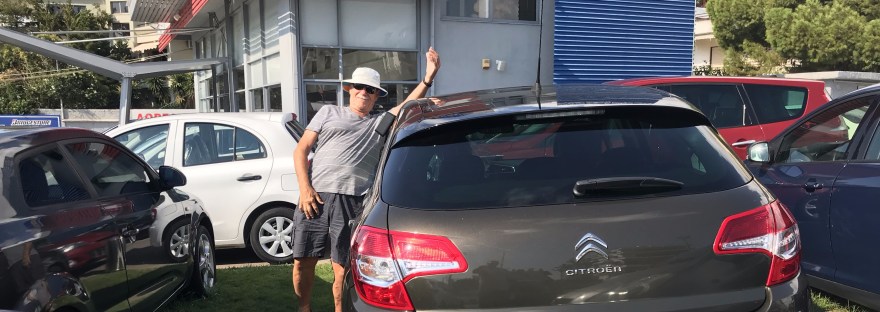
Two months later, i.e., this week, Demetri, weary of online car research and the debates in his own head (how old is too old? a tiny car is good for parking and ferries; a larger car will protect us all better.  Diesel might be easier to resell because of the cost of gas), he went to test drive three cars that had risen to the top of his long, detailed spreadsheet.  He came back having purchased one of them — a Citroen that is small enough to park, large enough to protect us in a crash, an efficient engine that has some power to get up the Greek mountains, new enough to have some decent technology, old enough to justify the cost.  The color is ‘cafe.’  How quintessentially, adorably French.

We remain optimistic despite having been here before.  The good news is that all of the car keys were accessible and test driving was no problem.  A new battery & full check-up is guaranteed.  Paperwork seemed to go smoothly, though we are expecting some sort of paperwork crisis in a few days just because it’s how Greeks roll. (Last time it was that we didn’t have Greek ID, except we do — our visas — but it’s not acceptable even though it’s official or something.  We are still confused about that.)   Papou will (say it with me) rescue us if that happens again. So, a few more days and we expect to have wheels.

About that: it takes a week or so between purchase and possession.  Unlike the US, the license plate is assigned to the car for its life, rather than being assigned to the driver. That means the dealership handles getting the plates assigned to you and all of the other DMV-like tasks, but that process doesn’t move quickly.

I hope writing about it doesn’t jinx it. On the other hand, the story will get even funnier with another chapter.