Travels

Naples

Naples: home of Elena Ferrante and her Neapolitan novel series, limoncello, bufala mozzarella, and sfogliatelle, which is as fun to eat as it is to say. Well, actually it’s kind of messy but it’s delicious nonetheless.

We stayed in an 18th century apartment in a 4 story building that was originally a family home in the historic center of Naples.  It is decorated in 18th century style and the ceilings must be 20 feet tall.  Our street, via dei Tribunali, was the main east west street of the ancient, thriving Greek and Roman city of Neapolis. We were blocks from the best Neapolitan pizzerias in town and just down from the Duomo di Napoli.  Naples had great wealth from the ancient times until Italian unification, but after it joined the united Italy in the late 1800s, its wealth was used to fund industrial expansion in the north, so the city lost its glamour. It was also the most bombed Italian city in World War II, as Naples was the first Italian city to rise up against German occupation.

The city has a scrappy feel (my man Rick Steves calls it a ‘tangled mess’) compared to other Italian cities, maybe thanks to influence from the Camorra, Naples’ mafia, which is the oldest crime organization in the country, dating back to the 17th century. It has lots of pretty areas and charm once you get used to the noise, the brazen scooters and the alley-like streets.

Our first day we walked the city, starting at the top rated sfogliatelle bakery, then taking funiculars from the old center to various points around town, ending the day along the water and through the Piazza del Plebiscito where the lights on the church reminded us of Denver’s civic center building. We stopped for dinner at an antique pizzeria where a popular, famous pizza was invented and named for Queen Margherita di Savoia. (The margherita pizza, of course.)

We spent our second day in Pompeii, the ancient Roman town that was destroyed in 79 AD when Mount Vesuvius erupted and buried the area under 15-20 feet of volcanic ash.  The site was unknown for some 1500 years until the mid 1750s.  The town and the objects found in it have been perfectly preserved because of the lack of air and moisture – and the artifacts gave historians detailed information and insight into life in an ancient Roman city. Walking through the ruins, you immediately notice how organized and efficient the city was planned out: market in the center, villas on one side, smaller houses on the other.  Public areas close to the center, an amphitheater, roads for chariots and sewer waste.  During excavation, plaster was used to fill in the spaces of the ash layers that once held human bodies, so archaeologists could see the exact position the people were in when they died. It was fascinating.

It was dark when we left Pompeii.  From there we continued on the train to Sorrento, home of the famous lemons that make limoncello. It’s a beautiful area of Italy, with the Amalfi coast just to the east and the island of Capri right offshore.  The buildings that stack from the top of the city down to the water gives it a cool dramatic look from the bottom. The holiday decorations were beautiful and the main square is really pretty. We had a quick dinner in Sorrento before boarding the train back to Naples that night.  And from here, naturally, all roads lead to Rome.

Oh, and the cover picture on this page is a nativity scene made entirely of pizza.

Travels

Florence

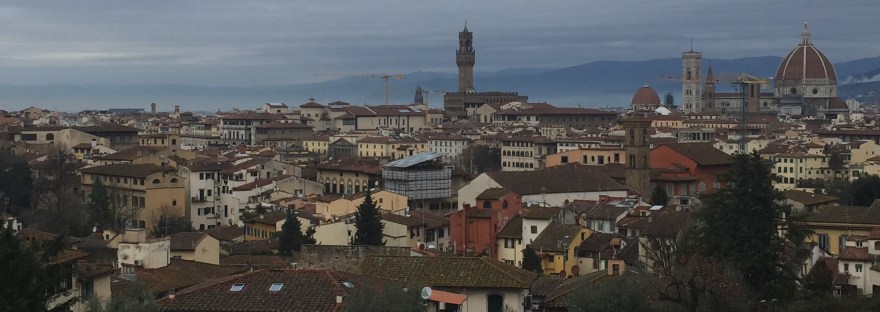
Forget the many museums and galleries and churches with art, Florence is an open-air museum all on its own.  You don’t have to step into any of these famous collections to see the beauty of the Italian Renaissance (except you really must).  This was Demetri’s third visit, and Tyler’s and my second.  Michael was thrilled that his beloved statue of Perseus and Medusa was basically right outside of our apartment in Piazza della Signoria, so it was the first thing we went to see when we arrived, and we got to pass by it pretty much every time we went anywhere.  Bonus.

Piazza della Signoria is the square right in front of the Palazzo Vecchio, perhaps the most famous meeting point in the city.  It’s home to the gorgeous statue of Neptune and several other statues; in the middle ages, this is where people were burned at the stake.

Florence, of course, was home to the Medici, perhaps the most famed noble family in Europe.  They ‘ruled’ from 1569 until 1737.  Lorenzo de’ Medici was a political and cultural mastermind, controlling things from behind the scenes. The Medici were bankers to the Vatican, so they essentially controlled the papacy, and they were great backers of the arts, commissioning hundreds of painters, sculptors and musicians. A few times, Florentines would drive the Medici out, but they were soon back in power.

We had an excellent guided tour of the Uffizi Gallery. Uffizi means ‘offices’ in Italian, and this building was exactly that – the Medici family used this building as offices, and very important guests were invited to the top floors to view the family’s collection of art and sculpture. In 1769, the building was opened as a museum. The gallery has an outstanding collection of ancient sculptures and paintings from the Middle Ages to the modern period and is home to masterpieces by Giotto, Filippo Lippi, Botticelli, Leonardo, Rapahel, Michelangelo and Caravaggio.

The boys were completely enthralled by our guide and the way she explained what we were seeing. They were silent and thoughtful through the entire 90 minute tour and Peter even raised his hand and asked a question.  They also loved wearing the radios and headsets, so the couple of times they got bored I heard them pretending to talk to each other through the radios. Our guide was terrific – she was an art student from Russia who had such enthusiasm for what we were seeing that it was impossible not to get as excited about it as she was.  Her mom called a couple of times during our tour which was pretty hilarious and she may have been wearing pajamas, but none of it mattered because she was fantastic.  We will always opt for a guided tour from now on.  After the Uffizi, we had a long lunch on the other side of the river and then walked into the Basilica di Santo Spirito, designed by Brunelleschi. There was a cool, almost interactive nativity scene in there.  We walked home from there, stopping quickly into the Michelin rated restaurant where Demetri’s cousin Andreas is a chef just to say hello. He showed us around the kitchen and the restaurant, where every nightly reservation is filled no matter the day. From there, we walked to the Basilica di Santa Maria del Fiore (the Duomo), also designed by Brunelleschi and the bell tower by Giotto.

Tuscan food is really great. Ribollita, a winter soup made from vegetables and bread, was our favorite.  The Bolognese is made with wild boar, there is a lovely tortellini in broth (brodo), and of course the famous bistecca alla Florentine, an enormous T-bone steak that comes only from the Chianina cow found in Tuscany. Sweets? Tiramisu, coronettos filled with traditional apricot and untraditional but still yummy blackberry and cherry, a pine nut cake and of course gelato, which was invented in Florence.

One of Demetri’s best friends from high school was also in Florence, so New Year’s Eve day we spent with Dan and Camilla over a fun, long lunch of traditional Tuscan dishes (see above). Camilla is from Prato, a city just outside of Florence and it was really fun to talk with her about Italy and Tuscany. Dan drew electric guitars and skulls in both the boys’ books and later I found tons of photos of those illustrations on my phone.  They think Dan is the coolest ever.  We walked a bit, stopped in some cashmere shops and spent a little time in Piazza Republica together.

New Year’s Eve night we walked to the Basilica di Santa Croce, where the who’s who of the Italian Renaissance are buried – Michelangelo, Machiavelli, Gallileo.  Then we trekked back up the hill on the other side of the river for a celebration in Piazza Michelangelo, where there were cover bands, food, drinks, and sky lanterns galore.  We rang in the New Year in Piazza della Signoria, watching an orchestra for a bit before the clock struck 12.  The thousand or so other people in the square all had bottles of champagne and to our delight it was not for shaking and drenching the crowd, it was for drinking!  Fireworks were lit all night – some shook the windows in our apartment – and there was lots of puke all over the place the next day.

Demetri got up after only three hours of sleep to run back up the hill and see the sunrise on the first day of the year from Piazza Michelangelo.  It was raining, but still a beautiful view of Florence.  We spent the first day of the New Year on the train heading south to Naples.


Travels

Milan

An Italian told me that Milan used to be only a ‘business’ city.  Some Italians liked it that way – maybe they felt they had this gorgeous place all to themselves while there for work.  While still very much a business city (it’s said that for every church in Florence there’s a bank in Milan), it felt very livable. Demetri thought it felt like Paris mixed with Chicago. The apartment buildings are grand, public transport is easy and clean, people are polite, traffic moves at a sensible pace, it’s busy but not packed (except for the center), it has nice parks and dog parks and a neighborly feel.

We arrived from Venice in the pouring rain, taking the subway from the train station to the stop near our apartment.  We came inside, changed into some dry clothes and went back out again to see the cathedral (Duomo), La Scala, the statue of Leonardo DaVinci and the Galleria, one of the most majestic and oldest shopping malls, built in 1867. The Duomo is spectacular, with 3600 statues and 135 spires on top of the cathedral. It’s the third largest Gothic cathedral in the world.

Leonardo DaVinci left Florence for Milan and worked there from 1482-1499. The Duke of Milan lured him north and commissioned him to do several things – and in his CV, Leonardo told the Duke all the things he could engineer, design and build  … and oh, by the way he could paint too, you know, if he needed that.  We visited a DaVinci museum that had some super interactive displays and a really cool digital restoration of DaVinci’s Last Supper with stories about all the apostles and why they were painted as they were.  DaVinci’s ‘real’ Last Supper is hanging in the Basilica of Santa Maria Della Grazi, a plain looking church just a block from our apartment.

We also visited one of the libraries that houses many of Leonardo’s papers and notebooks. It’s also home to a giant sketch (the museum called it a ‘cartoon’) of Raphael’s School of Athens, Demetri’s #1 fave, but sadly they are in the middle of restoring it, so we only got to see a movie about the restoration and a digital photo of it.  Interestingly, the sketch is about twice the size of the painting hanging in the Vatican.

The boys were fascinated by three frescoes that told the story of Noah in the church of San Maurizio al Monastero Maggiore. The docent grabbed us saying he had something for ‘the bambini’.  The animals were painted in great detail and there were hundreds of them.  He spoke to us in Italian, but thanks to his hand gestures and a few words I know,  we heard the story.  Much to the boys’ surprise, a set of unicorns were third in line up the ramp, so that set off a long discussion. I’ve been saying for years that unicorns don’t exist because they never made it onto the Ark.  Now I need to find out why they got out of line if they were so close to the entrance.

We had some great morning runs through the city center to Sforza Castle and the park behind it, past lots of little and big churches, past the Science/Technology Museum and through the neighborhood where we stayed. Michael had a random puke one morning so we got a later start than planned after washing sheets and pajamas and so forth.  We ate well: Risotto Milanese, paninis with a choice of one out of four types of prosciutto, artichokes everywhere and beautiful panettone cakes, traditional for Christmas that originated in Milan.

Walter Isaccson’s biography of Leonardo DaVinci is really worth reading — or listening to on Audible.

We took the #10 antique tram the long way through the city to sightsee on our way out of town. Tyler met us at the Milan train terminal – he flew in from NY that morning – and we set off together for Florence.

Once Tyler arrived, Peter refused to hold anyone else’s hand.