Greek life

A word about housekeeping

Greek women keep a very fastidious home.  They cook every day and when they aren’t cooking, they are going to the markets — butcher, produce, fourno (bakeries), zaxaroplastio (pastry shops). They beat rugs.  They iron clean laundry down to underwear, towels and sheets.  (No clothes dryers, remember?)  And their cleaning should win medals.

My cleaning skills are fine.  Good even, especially when someone important or discerning is visiting. I subscribe to the philosophy that you must have a party at least quarterly because it really makes you clean out and scrub stuff.  (Sadly, I don’t have quarterly parties).  I have toothbrushes for grout, a really good vacuum for floors, swiffers, disinfecting wipes, rags for scrubbing floors on my hands and knees, microfiber dust cloths.  I clean the bathrooms weekly or more.  (There are 4 boys in my house; ‘ nuf said).  I learned from Allison to clean myself into the shower.  But I’m also on the lazy side, so I don’t exactly clean myself into the shower every day.  I triage cleaning. Or I hire it out.

Voula is a breezy place.  The Sirocco winds (hot; from Africa) and the Meltemi winds (cooler, from the north-ish)  make it downright windy.  There is a lot of sand, dirt, Bougainvillea leaves and concrete particles flying around.  Greeks also prefer fresh air to air conditioning, even up to say 39 degrees celsius, so veranda doors are usually open all the way.  Our apartment has four beautiful verandas, views of the sea from all of them, and marble floors.  And with no screen doors (rare), they get dirty fast.  Daily mopping is pretty much mandatory.

I didn’t believe this.  But after washing our feet 4 times a day and crunching on stuff walking through the living room, I realized that my ‘fine’ cleaning skills are woefully inadequate.  I vaccuum & sweep everything, and then I start mopping.  It took me about five days to get a sweep/mop/rinse procedure down.  I think I’ve gotten faster…? And I think we’re washing feet only before bed.  Or maybe they’re just not telling me.  But it sure smells good in here.  I hope I can import the super smelling “Pronto” into the States when we return.

Off to the produce stand …
Greek life, Travels

Peloponnesian road trip

The purchase of a car necessitated a road trip.  We returned the car (story in a future post) but we went on the road trip anyway in a rental.  The Peloponnese are the ‘fingers’ to the west of the mainland.  It is a beautiful area.  We spent time on the far west coast (Pilos, Stupa, Kalamata, Costa Navarino) in 2014. In 2016, we spent a long weekend in Loutraki, near the Corinth canal.  The Peloponnese region was quite significant in Greek history — the Peloponnesian Wars (431-404 BC) essentially took power away from the Athens city-state, and established Sparta, the leading power of the Peloponnesian League as the dominant force. These wars were the abrupt end of the golden age of ancient Greece.

This time, our destination was a town called Korfos, a village on the sea.  Papou and Sandy came too and we had a little townhouse with a lovely garden that was just up from the water.  We crossed the Corinth canal, stopping to watch some boats travel through, arrived about 5 pm, swam at the pool, had some wine and snacks, and went to dinner later at a little Taverna on the water.

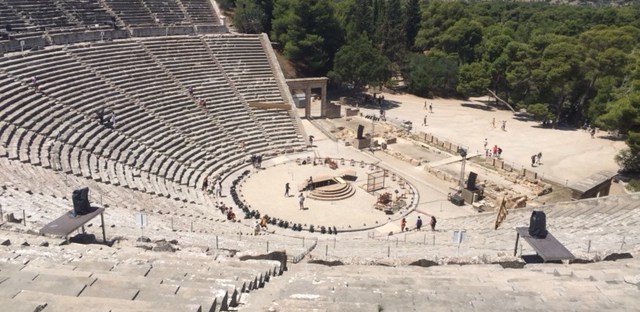
The next morning, the four of us drove to the ancient Theater of Epidavros. Built in the 6th Century BC, it is one of the most perfectly preserved sites from its time.  The acoustics are terrific — we could hear a coin drop on the stage while we were at the very top.  In the same site was a temple dedicated to Apollo Meleatas, a god with healing properties, and the Asclepieion, the seat of antiquity’s physician god — people started worshipping him in the 6th century. There were also dormitories, a stadium, and ancient market.

We left Epidavros and drove to Porto Cheli, a little harbor town. From there we took a water taxi to the island of Spetsis, one the Saronic islands.  Spetsis is adorable. No cars are allowed, so you get around by motor scooter, taxi or horse carriage. We stopped for a late lunch near the harbor and wandered down the streets lined with lovely boutiques and shops.  Then we took a quick swim, diving into the ocean from a pier.  It was terribly hot so our tempers and bodies cooled down nicely with a little swimming.  Then we took a water taxi back to Porto Cheli and the car, and drove along the coast back to Korfos.  Papou and Sandy spent the day closer to home at Metamorfosi and other towns.  Demetri, Sandy and I have all just finished Blue Skies and Black Olivesa really funny father/son account of building a house in Greece.  Demetri found the house on our way back, and though Papou felt we should knock on the door and tell him how much we enjoyed the read, we didn’t.  We stopped for ice cream in Galatsas and headed home.

Saturday we woke late, swam in the pool for a little while, and drove to Drepano Beach. Saw many goats and goat herders along the way.  Papou’s first cousin Elena — a Greek who has lived in Florence since birth — spends summers in Drepano.  Elena is funny, charismatic, and full of life.  The perfect mix of what an Italian Greek should be.  The water in Drepano is the best I’ve ever seen. The beach is rocky, but the water in the ocean has soft sand for miles.  The water was so clear it looked like a swimming pool with a sand bottom.  We swam for a bit, then went back to Elena’s apartment for a linguine with mushrooms and truffles pasta lunch.  It was her husband’s birthday (Massimo).  There was champagne, fresh cheese from Florence and Greece, and the most beautiful fruit tart birthday cake with grapes, figs, apples and plums.  Elena’s brother (Renato) and his wife (Ornella) also joined us.  I didn’t know until yesterday that Papou speaks Italian, so he was the hardest working guy at the party, translating from Greek to English to Italian to English and back to Greek.

Next stop, Rodos.

Greek life

My name is Demetri and I’m a figtarian

Syka is the Greek word for fig. And just this week the figs are getting to the grocery stores and better yet, the fruit stands. Yesterday I drove with Papou to Markoupoulo, a town near the Athens airport where most of the figs come from. (First we went to a farmers market on the way to get olive oil, homemade pasta and nuts — I found a Costco-sized bag of cashews for half the Costco price!) Papou likes one particular Syka man on a road outside of town next to a a temple dedicated to Artemis. They spent a minute negotiating and guessing each other’s ages and then we bought a case of green royal beauties. They are sweet, bright red and incredibly delicious. He threw in a couple of black ones saying they’re better than the green ones and that I’ll come back next week asking for only black.  Demetri says he’s going to eat only figs in August, so this case should last us through tomorrow.  Along with fig season comes grape season, and the peaches will be good for another month, much to my delight. And the karpuzi — watermelon — is in season through September.

Greek life, Travels

Syros


Demetri attended a language class on Syros, the capital of the Cyclades this last week.  The class was great — he was the only US citizen in the group — and he was out each day around 2 so he could do his homework and enjoy some of the island.

There is a bit of money on Syros and it’s well populated — 22,000 or thereabouts, with most of the folks living in the city of Ermoupolis, named for Hermes, the wing-footed god of trade and business.  It was the busiest and most important port in Greece for many years, even more so than Piraeus.  There is also a great deal of culture in the city, including the pretty Apollo Opera House, modeled after La Scala in Milan. Demetri and his dad saw Madam Butterfly one night while we were here.

The kids, Sandy, Peter and I spent most of the days at the swimming pool at The Sunrise Beach Suites in the beach town of Azolimnos.  In the evenings we enjoyed Ermopoulis and its pedestrian walkway streets, the Plateia Maniouli square, and the churches of Agios Nikolas (the patron Saint of sailors) and the hilltop Church of Resurrection.

Syros is different looking than other Cycladic islands.  It has a lot of Venetian influence in the architecture, and the city of Ermoupoulis is almost all neo-classical architecture instead of the traditional Cycladic look (though there are lots of that for sure).  Syros is the one island that was never occupied by the Turks — it was under Vatican protection for years and there is a strong catholic culture on the island.  The Catholic Church (St. George) on the opposite hill of the orthodox Church of the Resurrection, has been destroyed and rebuilt FIVE TIMES on the same spot.  Lighting hits the bell tower rather frequently.

Papou, the kids and I spent a morning in the medieval town of Ano Syros which is home to St. George, another Agios Nikolas (St. Nicholas) and winding narrow streets and a cafe with a spectacular view.

Our fabulous week came to an end with the arrival of the Naxos Blue Star Ferry, which took us back to Piraeus yesterday.  Two weeks of island living was great and we’re already planning our next trip!  Rhodes is in the plan for August, maybe Kos and Patmos as well.  More on that later.

Greek life

Read anything good lately?

On the 6 hour ferry ride from Milos to Syros by way of Kimolos, Sifnos, Serifos & Kithnos, I finished The Full Catastrophe – Travels Among the New Greek Ruins by James Angelos, a journalist and former WSJ reporter.  His book, titled after a line from the movie Zorba the Greek, describes the longstanding corruption in Greek politics and how it helped lead to the debt crisis, the dependence Greece has on Europe (Germany in particular) and the animosity for same.  Angelos’ writing is funny – particularly in his descriptions of the people he met and interviewed, and the book goes into depth on the changes in Greece that have emerged in the wake of “the crisis,” as all Greeks call it, and not many of them are good.  The chapters on immigration and nationalization are particularly fascinating.  This is my 5th visit to Greece and this book explained much of what I’ve seen and not understood both politically and culturally.  Angelos notes, and I completely agree, that Greece remains a must-visit country.  The people are generous and kind, and the country is beautiful.  The financial and political future, and whether Greece can enact profound political change and become more self sufficient is the question that Angelos raises.  If you’re at all interested in this topic, give this book a read.  It was terrific.