Greek life

48 Greek foods everyone should try

Everyone knows the gyro.   And the scene from “My Big Fat Greek Wedding” where Aunt Voula tells Ian, the non-Greek vegetarian fiancé, that lamb is not meat.  It’s like, beyond meat. Vegetarians can totally eat it.

Roberta’s visit last week — and our search for different foods as we tooled around — inspired me to make a list of our faves; the ones we think everyone ought to try.  Why 48?  The number is staring me down. My birthday is this week.

These are not ranked.  Trying to assign a position … a number … a grade … to these is pure agony.  So instead they’re sort of grouped together as you’d see on a menu: appetizers and salads, main dishes, sides/veggies, desserts.

  1.  Pies:  tyropita (cheese), spanikopita (spinach), loukaniko (sausage), kotopoulo (chicken), kolokythopita (zucchini), prasopita (leek) … the list goes on forever.  It’s phyllo wrapped around some sort of savory goodness with cheese and herbs.  It might be a triangle. Or round. Maybe square. Perhaps D-shaped. Or long and skinny.  You find them everywhere, thank heavens. Katerina taught me how to make a big batch of them in 2011.  Hers are better than mine.
  2. Pastourmadopitakia – Phyllo dough with cheese and pastourma (like pastrami).  Fried before serving for extra love.
  3. Koulouri: A round bread product covered in sesame seeds.  Looks like a lanky bagel. Michael in particular loves them.
  4. Kalamarakia: Lightly fried kalamari.  It’s so fresh and soft.
  5. Horiatiki salata: A salad of tomatoes, cucumber, onion, green pepper and olives with rectangular hunk of feta on top, dressed with olive oil, oregano and red wine vinegar.  Sometimes a few capers might be tossed in too.
  6. Horta: Boiled greens, e.g., chard, dandelions, purslane, fennel leaves, beetroot, etc.,  served with olive oil and lemon.  Horta literally means ‘weeds,’ though it’s nicer to say ‘wild mountain greens.’
  7. Fava: Not fava at all, but rather yellow split peas, pureed and topped with capers, scallions or red onions and olive oil.  It can be served cold; we like it warm.
  8. Fazolia: bean salad (black eyed peas are Demetri’s fave) with fresh dill and finely chopped red onion and dressed with olive oil.
  9. Spring salad:  Lettuce, scallions, and tons of dill with a lemon-olive oil dressing.  Bright spring flavors that are traditional for Easter.
  10. Dakos:  A Cretan salad with a crunchy rusk about the size of a hamburger bun, topped with a mixture of chopped tomato, olive oil and onion. A chunk of feta goes on top.  The tomato softens the rusk.
  11. Xtopodi: Octopus.  Often grilled and made into a salad with herbs and olive oil; also cooked with pasta in a red wine sauce.
  12. Tzatziki:  yogurt with garlic and cucumber and sometimes dill.  It’s served on gyros, but my favorite application is french fries.  Demetri’s brilliant kitchen hack: use the juicer to grate the cucumber.  Saves hours of straining.
  13. Taramosalata:  a salty spread made from fish roe.  Usually served with grilled pita bread; also good with cut up veggies.
  14. Gigantes: Giant white beans in tomato sauce with a lot of dill.  Our man Manoulis makes them in an olive oil sauce with tons of different herbs.
  15. Panzaria with skordalia:  Boiled or roasted sliced beets and served as a salad with a garlic sauce made from potatoes or bread crumbs.  ‘Skorda’ is garlic in Greek.
  16. Spanakorizo: Spinach, rice, onions, dill and tomato paste cooked on the stove. Vegan comfort food.
  17. Fakes (say fahk-ess): Lentils.  Usually a stew, sometimes a salad.   They can be red, black or the traditional greenish-brown.
  18. Revithia:  Garbanzo beans in a savory broth.  It has lemon juice to brighten.
  19. Fazolakia: Green beans in tomato sauce.  I feel like I’m insulting this dish by describing it so simply.  It’s the BEST.  I love it every time I eat or make it, but nobody can hold a candle to Manoulis.
  20. Artichokes with peas: Lots of dill in this one, plus usually a potato.  Cooked and served at room temperature.
  21. Patates lemonates: Roasted potatoes covered in olive oil, oregano and lemon.  I haven’t yet cracked the secret of crisping them up.
  22. Tiganetes patates: French fries. Greece does them well.
  23. Soutzouki with avga:  Soutzouki is a super spicy sausage; our favorite way to eat is with fried eggs and potatoes (french fries) served in a tiny little skillet fresh from the oven.
  24. Souvlaki: Pork, chicken or lamb grilled on a ‘little’ skewer.  Fun fact: bamboo skewers and drinking straws are both called ‘kalamaki’. If you order a chicken skewer, you ask for a ‘kotopoulo kalamaki.’  We had a funny confusion one night where one of our waitress pals offered Peter a straw (saying ‘kalamaki’) and he said, “no I don’t want kalamaki tonight, I want a gyro.”
  25. Kotosouvli: larger pieces of pork or chicken cooked on the souvla – the large metal skewer.
  26. Paidakia – grilled lamb chops.  Peter’s fave.
  27. Arni: Lamb in general; from the spit.  Little pieces of lamb are called ‘arnaki.’
  28. Kleftiko: Also called ‘lamb in the oven.’  Slow cooked in parchment; sometimes with vegetables.  Fantastic.
  29. Kebab:  Beef and spices rolled into a log and cooked on the grill.  My kids would eat them every night.  Sometimes they do eat them every night.
  30. Gyro (say ‘yee-roh’):  Shaved pork or chicken placed in a pita bread with tzatziki, tomatoes, onions and french fries (yep, inside).  Can be served deconstructed on a plate too; called a ‘portion.’  The gyros in Greece are so good. We like the gyros in the US with their beef/lamb meatloaf mixture, but the real thing is so much better.
  31. Moussaka: Layered casserole with eggplant, ground beef and tomato sauce and topped with bechamel.
  32. Giouvetsi: Oven baked dish with pasta and meat.  While it could be chicken, beef or pork, and the noodle can be any short one, the most traditional is beef and orzo.
  33. Pastitsio:  Hollow, thick spaghetti with ground beef and tomato sauce (that contains a hint of cinnamon), also topped with bechamel.  This was Demetri’s favorite food as a kid; his grandmother gave it to him as an after school snack.
  34. Gemista: Means ‘stuffed.’ Usually this is tomatoes and peppers stuffed with rice and then roasted in the oven until the vegetable is soft. Could be zucchini or eggplant too.
  35. Laxanadolmades: Cabbage leaves stuffed with ground beef and served in avgolemono (egg-lemon) sauce.  Zucchini can be served like this too.  This might be my favorite dinner.
  36. Papoutsakia:  Ground beef and cheese stuffed eggplants with either potato puree or bechamel on top. ‘Papoutsia’ is the word for shoes … and these kinda look like ’em.
  37. Soutzoukakia: log-shaped meatballs with hints of cumin and mint and sometimes ouzo in tomato sauce. Usually served over rice.  Once I grabbed what I thought was leftover spaghetti sauce from the freezer for dinner.  When it defrosted, I was beside myself with delight to discover it was Papou’s soutzoukakia made during his last visit.  I also think this is the only Greek meal my dad ever had.
  38. Keftedes: Lamb or beef or chicken or maybe pork meatballs.  Tiny ones are ‘keftedakia.’
  39. Giovarlakia: Meatballs with rice and herbs in avgolemono sauce.  Lovely.
  40. Psarosoupa: A hearty fish soup that’s filling but light at the same time.  Eat this for lunch in November when the weather turns.
  41. Greek yogurt:  10% fat.  It’s just that much better.  Best topped with honey and walnuts, not stirred around.
  42. Mezithropitakia: Pictured above.  Pastry stuffed with a sweetened mezithra cheese mixture and topped with a little cinnamon. Perfect with coffee.  Go for a run and bank some calories first.
  43. Portokalopita:  Yogurt cake with orange syrup.
  44. Spoon sweets: Fruit preserved in syrup … and there are hundreds of these. Eat solo on a spoon (duh) or over yogurt.  Papou’s favorite is quince, followed by sour cherry.  Katerina makes a mean one with grapes and almonds.
  45. Baklava: Layers of phyllo with walnuts and honey tucked inside. Kataifi is phyllo that looks like string with the same stuffing; just rolled up instead of layered.
  46. Bougatsa:  Phyllo with sweet cream inside, topped with powdered sugar.  If you come from Thessaloniki, ‘bougatsa’ means anything wrapped in phyllo; savory or sweet.  In Athens, bougatsa is only this sweet pie.
  47. Galaktoboureko: Sweet custard in phyllo in syrup. The Athens pastry shop, Kosmikon, makes theirs in kataifi dough.  Tyler loves this one so much that Papou bought a whole cake for only Tyler last year, and left a note saying so.
  48. Loukoumades:  In a word, donut.  Fried dough with sugar or powdered sugar.

Honorable mention: cheese

Cheese has ancient roots. Strainers have been found all over the country starting in the Neolithic period.  Carvings in the Minoan palace of Knossos on the island of Crete depict men making cheese from goat milk.  Most Greek cheese is made from goat or sheep milk. These animals are native to Greece; the rugged landscape isn’t very conducive for cow pastures.

Each island boasts its own special cheese, e.g., San Mixalis only comes from Syros; Graviera is ubiquitous but Naxos has its own.  Kefalograviera is different than just Graviera.  And there are tons of feta varieties — be decisive when at the cheese counter. Halloumi is grilled and placed atop salads. It squeaks on your teeth. Cheeses are are salty, creamy or nutty. They can be grilled, flambe, mixed together in a pie or eaten as an appetizer with olives. Some are sweetened up for desserts. It’s fun to travel and sample cheeses special to that region.

Extra credit: drinks

  1. Ouzo: Aperitif liquor made from grapes with anise added, giving it a liquorice flavor. Try it on a really hot day in a glass of ice water.
  2. Masticha: Digestif liquor made from the ‘tears’ of masticha trees, found only on the island of Chios.
  3. Tsipouro:  Digestif liquor made from grapes. I like this one with lots of ice.
  4. Raki, from Crete, is similar to tsipouro.  Also a digestif.
  5. CoffeeGreek coffee (ellinikos kafes) is specially made in a briki – a little pot with a long handle.  The coffee is boiled with sugar and served thick and dark. These days, the coffee shops always make greek coffee, but more popular are the espresso drinks, especially the cold ones.  Baristas mix the sugar (most Greeks put sugar in their coffee) into the espresso and give it a healthy stir so it all dissolves. Drink it plain over ice and you have a freddo espresso.  Add whipped milk or whipped krema (cream) and you’ve got a freddo cappucino. Nurse it for more than an hour and you are a true Greek.

I’d love to hear your favorites.  Did I miss anything you love?

photo from mygreekdish.com

Greek life, Travels

Mycenae

My friend Roberta – we met in junior high soccer – came for a visit last week.  All by herself, which disappointed Michael and Peter since she and her husband have three fabulous daughters who both my boys adore.  Since Roberta had been to Athens before, we decided on a few ‘second visit’ things to do, like the Elias Lalaounis jewelry museum (a fave), and the Benizelos (Μπενιζελωσ — not to be confused with Venizelos) mansion, a quick trip to Nafplio, Epidaurus and Mycenae.

The Benizelos mansion is really neat.  Nestled in between shops and tavernas on Adrianou Street, it sits just in front of the Roman Agora.  Built in the 16th century, it’s the oldest surviving house in Athens.  It’s a typical urban nobility house from the Ottoman period. The upper floor is sort of a labyrinth made of timber.  The home’s most famous inhabitant was Revoula Benizelos, later martyred as St. Philothei, a woman who after being widowed very young, started a monastery that gave shelter, food and care to the poor and also provided refuge to slaves and Muslim women who had converted to Christianity. The Turks killed her for that in the late 1500s; she is one of the only saints to have been martyred during Ottoman rule.

Our next stop was Mycenae, home to the ancient civilization renowned for its technical advancements as well as artistic wealth — which played an important role in the development of classical Greece and its culture.  The ruins of this fortified citadel date back to 1600 BC and the most impressive element of Mycenae are its tombs, in which archaeologists found jewelry, weapons and tools, plus things that came from other parts of the world: ivory, tin, even lapis. The Myceneans were among the first to use bronze and it was here that the first pieces of the Greek language, preserved on Linear B tables, were discovered.  Mythology says Mycenae was founded by Perseus who employed the Cyclopes to build the city walls from rocks that no human could lift.  It’s also said to be the inspiration for Homer’s epic poem. Its most famous king was Agamemnon, who helped his brother Menelaus rescue Menelaus’ wife Helen, during the Trojan War (yes, that Helen).  Agamemnon and his wife Clytemnestra had two children, Orestes and Electra.  After Clytemnestra and her lover murdered Agamemnon in the bathtub, Electra and Orestes spent years working to avenge their father’s death.  I think I have this right.

Now, I knew this story from high school English class and the great play by Euripides.  In the 19th century, archaeologists found the bronze burial mask of King Agamemnon … and they excavated the bathtub he died in.  Turns out Agamemnon may not have been a fictional character at all.  You can find this mask in the National Archaeological Museum in Athens.


Greek life

Museum marathon

Having visitors is a great way to check off things to see in your city.  Erin, Demetri and I attacked Athens sites this week, logging some 70 miles on foot with good coffee and snacks and fun visits with cousins along the way.

The Acropolis and the Acropolis Museum are the obvious first site choices.  While Demetri has visited the museum many times, my first visit was this week.  I missed it in 2006 (not built yet) and then in ’11, ’14 and ’16 we opted not to do museums with tiny kids in tow.  But it was worth the wait: its collection and multi-media exhibits are  excellent.  And the Acropolis museum has a 5 for 1 ticket that gets you into several other sites and is good for 5 days.  As for the Parthenon and other sites on the Acropolis itself, everyone should go to the top and see it in person. While it’s visible from many points in the city and the night views (say, from a rooftop bar in Monasteraki) are definitely the best, there’s nothing like seeing the tree that Athena planted herself when the city was named for her.  Yeah, so not really but you still have to go see the tree and imagine Athena and Poseidon fighting over who should be the city protector.

The Museum of Cycladic Art is one of the newest museums in Athens and is located downtown in Kolonaki. Its benefactors are a couple who were sick and tired of all of the looting of antiquities on the islands. Naturally, its signature collection is ceramics, statues and other pieces from the Cycladic island group, but it has other prehistoric and ancient art, a great exhibit on Cyprus, and a temporary exhibit about coins and money.  Fun fact: the drachma, Greece’s currency before it adopted the euro in 2001, comes from an ancient word for ‘fist full.’   This may explain the exchange rate in the 1980s when two other little Fefes boys had hundreds of drachmas to buy $3 worth of ice cream. Fist full indeed.

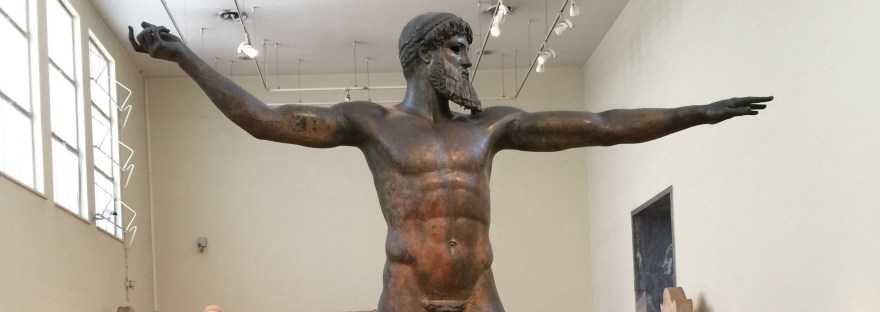
The National Archaeological Museum, along with the Benaki and the Acropolis museum, rounds out the city’s top three.  Erin and I really enjoyed seeing the wall paintings and frescoes that were excavated from Akrotiri – some of which are in situ in a special exhibit in this museum.  The collection in this museum is so well laid out … from Neolithic to the Bronze Age to the Classical period and Byzantium, its collection is vast but somehow doesn’t feel overwhelming.  I think this museum is one that kids would like, especially with a guide who can tell the stories and myths behind all these nifty pieces. Aside from the Akrotiri frescoes, the museum’s best known pieces are two bronze statues – one of a horse with a jockey, the other of Poseidon, and the Antikythera Device, an ancient computer used to predict astronomical positions and eclipses for the calendar, and it also tracked the ancient athletic games.

When Athens became part of the (relatively unified) eastern part of the Roman Empire/Byzantium, Roman influence invaded the city — but in a peaceful way, except for maybe the religion part. The Flavian Dynasty (famous for the Roman Colosseum) in particular left a nice mark on Athens with Hadrian’s Library and Hadrian’s Arch, two giant monuments right in the city center.  There’s also the Roman Agora, a mini-Forum. The Ancient Athenian Agora, which was established, built and added to way before the Romans set foot in Greece, is really impressive. There must be 30ish structures that are/were in place.  One building has been rebuilt to give a sense of what the market was like and has a great little museum, and on the opposite side, the Temple of Hephaestus is incredibly well preserved. The Agora is perfect for a walk — with or without kids.

The sleeper of the week, the National Historical Museum, is an absolutely lovely museum in the old Parliament Building on Stadiou Street.  It is more of a modern political and cultural historical museum and after visiting here, you get a much better sense of the Greek struggle under Turkish occupation. This museum had a terrific World War I exhibit with political cartoons from the early 1900s.  I wish I’d taken pictures of those illustrations; they were one of the best visuals I’ve seen of the power struggles in Europe for domination across the globe.

One of the most astonishing themes in visiting all these museums is how many antiquities have been made off with by other countries.  Lord Elgin ‘took’ two marble statues from the Parthenon for the British Museum.  A Delacroix sits in the Louvre that should be in the National Historical Museum.  Greek authorities confiscated paintings and statues from Germany and they have recovered countless things from the sea, in transit outside the Mediterranean. And then of course, there are the Turks.

And now for something completely different, it’s Spring Break as of 2:30 yesterday afternoon. Disney Paris, here we come.

Greek life, Travels

Independence Day and Nafplio

Constantinople fell to the Ottoman Empire in 1453, and for the next 400 years, Greece attempted several (unsuccessful) revolts. In 1814, a secret liberation organization was founded and made plans for several simultaneous revolts in four or five locations around the country. Planned for March 25, 1821, the revolution got started a little early as someone let slip to the Turks what was going on. As in any war, there were major, significant battles — Hydra, Navarino, Missolonghi — between 1821 and 1829. The Turks aligned with Egypt, who sent an enormous fleet to help defend Ottoman holdings. Greece was eventually aided by Britain, France and Russia — funds, fleets, soldiers. In fact, Lord Byron believed so devoutly in the Greek cause he came to fight and died in battle.

Fighting ended in 1829 and Greece was finally recognized as an independent nation via the Treaty of Constantinople in 1832.

That was a very brief summary of the most important event of modern Greek history. It’s been fascinating to learn about the Turkish oppression that led to revolution and see how it factors significantly into today’s national culture. It explains so much — at least we think so — about life and attitudes in Greece.  A country invaded and occupied by others makes for an incredible national spirit.

March 25 is Independence Day. We learned last week that the Education Ministry directs all schools to celebrate various national holidays and the 2018 programs were to be held Friday the 23rd. Michael had a role in Kessaris’ program: reading a stanza of a poem (in Greek of course) to the lower school. He crushed it — and Papou and Aunt Ernie were there to see it.

Our friends the Schumachers are visiting, so we planned a weekend with them (and Erin) in Nafplio, a beautiful city on the water in the Peloponnese, just across the Corinth canal. Nafplio was the capital of Greece before Athens, and it was an Ottoman stronghold in the war of independence.  It was first invaded and occupied in the 1600s by the Venetians and has a huge fortress on top of the hill. We spent hours climbing in and around various walls, trails and innards.  We even found the cell of Theodoros Kolkotronis, the pre-eminent leader of the war of independence.  The cell was awful: dark, stinky, not a smooth surface in the place.  Kolkotronis was convicted for treason; he was just one of many revolutionary heroes jailed and exiled post-war as enemies of the state.

On the 25th, there were parades and celebrations all over Greece with military marches and lots of people in traditional clothing. 25 March is also an important religious holiday: the feast of the Annunciation (Evangelismos). The celebration of the Virgin Mary is a joyful holy day and one of only two days during the 40-day Lenten fast that allows fish, oil and wine to be consumed. Palm Sunday is the other day; it’s next week.

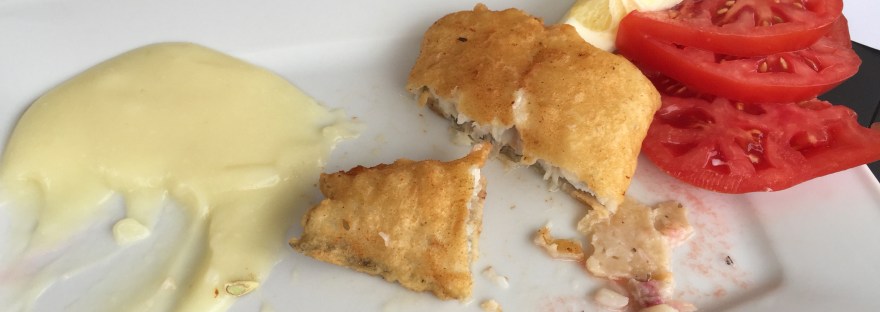
Since the 15th century, the traditional food for this holiday is fried cod (tiganitos bakaliaros) with garlic sauce (skordalia).   Cod isn’t native to the Mediterranean sea, but it’s quite prolific in the North Atlantic and it can be cured, making it inexpensive and simple to preserve.  Skordalia is made from either potatoes or bread crumbs and it’s got lots of garlic in it.  It’s often served with beets or just with some bread.

We hugged the Schumachers goodbye as they headed to the rest of their vacation in the Peloponnese. We headed for Athens, blissfully unaware that the clock in the car had not been changed for daylight savings.


Greek life, Travels

Santorini

Erin, my sister, arrived last Thursday for a two week visit that is going way too fast. Earlier this week we flew to Santorini, probably the most well-known island at the southernmost end of the Cyclades. Volcanic activity (massive eruptions every 20,000 years) began 1.5 million years ago; today the crater of the volcano is located under the sea.

The last eruption in the 17th century BC destroyed the flourishing city of Akrotiri. It appears the city was abandoned pre-eruption so the citizens must have had some warning of what was coming. Like Pompei, the volcanic material that covered the city has provided excellent protection from prehistoric times until now.

It is estimated that only 3% of the city has been excavated (3% of 20 hectacres, that is), and what has been explored is likely the city center, as evidenced by the density of the buildings, the paved streets, an extensive sewer network connected to the sanitary features in the houses (yep, indoor toilets in 1700 BC) and the outside animal stables. More evidence of Akrotiri’s sophisticated society are the many frescoes and paintings in the residential section of the city’s multi-story buildings. The paintings prove some commercial exchange with Syria and Egypt; and also with the Minoan settlements on Crete, 60 miles south and visible on a clear day.

Akrotiri is beyond impressive. There have been legends for years that Akrotiri is the lost city of Atlantis, but it’s never been proven. Artifacts from Akrotiri are housed in the Museum of Prehsitoric Thira on Santorini and in the National Archaeological Museum in Athens.

When Demetri and I visited Santorini in 2006, Akrotiri was closed because of a roof collapse and replacement.  Today, the site is housed with one roof; it provides ventilation and natural light and its inside temperatures allow tourists and archaeologists comfort even in the heat of the summer. The site has no energy-consuming mechanical support.

Santorini’s rich volcanic soil makes for excellent crops of tomatoes, fava beans and grapes.  Santorini wine was famous in ancient times all over the Mediterranean and remains a successful export even today.  Most of the grapes grown are white (assyrtiko is the most prolific), but there are a couple of varieties of red wines that are gaining popularity.  The island also has unique, cool beaches — red sand, black sand, plain ole tan sand and lots of rocks from which to jump.

Weather for us was excellent: sunny, mid-60s. We explored the whole island on foot and by car.  The villages of Thira, Firostefani, Imerovigli and Oia all sit cliffside on the caldera with fantastic views of the volcano and the famous Santorini sunsets.  Even though it’s off-season, the island was busy with tourists. All the locals were busy prepping and primping for the summer crowds — the smell of fresh paint was everywhere.

Our trip to Santorini was actually the second trip Erin and I had. Her first weekend, we ferried to Hydra for one night that turned to two because high winds prevented the hydrofoils from running. An extra night in pretty little Hydra is an unexpected gift — we were able to visit the Archives museum and learn a lot about the role that Hydra and its citizens played in the Greek war of independence. It was a great introduction to the national Independence Day holiday on March 25.