Greek life

Cousins

What is it about cousins just being instant pals?  It’s one of the marvels of the family unit in my opinion.  I didn’t grow up with a lot of cousins, and most of them are way younger than me, but when we visited each other, my siblings and I were always so excited and so happy to have them around.  It was like they were long lost best friends.

Demetri had the same dynamic.  He has four cousins that lived near him in New York — all considerably older than he and Michael were — and then he had cousins closer to his age in Greece.  He felt the same about them all.  He loved the older boys so much and when they would visit Greece, Thodoris and Anna were their best pals.  In fact, Anna took her first steps to Demetri at their house in Marathona.

Now that we’re all grown up, these cousins are our best friends here and with whom we most like to hang. But what I really love are the four kiddos: our two and Anna’s two. The dynamic is exactly the same as it was when Demetri was growing up: three boys and a girl, with the girl being the youngest.   And this ‘instant pal’ phenomenon was evident even when Michael and Giorgos were 4 years old and I realized that it didn’t matter that they didn’t speak the same language.  That trip, superheroes were the great cultural equalizer.  They would play at the house in Marathon, calling to each other in English and Greek, and Big Katerina (Anna’s mom, another cousin Demetri adores) would translate.  “We are on a mission!” “Let’s get the bad guys!”

The language barrier is getting noticeably smaller.  I hear Michael and George speaking Greek to each other when they compare soccer tags.  Peter, basically fluent at this point, runs around with Little Katerina calling and yelling to her.  And then sometimes they switch playmates.  George and Peter were riding scooters at the park together and talked to each other to coordinate what was next.   It’s so cute.  Living here has been awesome to connect the kids with their extended family — which was one of our hopes for our time in Greece.

This past weekend we spent all Saturday afternoon in the park with the 4 kids — Anna and me, that is, with special guest appearances by Katerina, Lampis and Thodoris.  Sunday we met a new friend, Rafael, at Vouliagmeni Beach and Thodoris and Mina came and met us for Sunday lunch and coffee. Next week for Sunday lunch, Aunt Ernie will be here.

Mina took the photo above. I love their happy faces.
Greek life

Culture Week

Greek culture is diverse, rich in tradition and defines the national spirit.  Culture itself — having it, that is — is incredibly important to Greek citizens. Many prominent Greeks — Stavros Niarchos, Aristotle Onassis, Melina Mercouri, The Benakis and Lalaounis families  to name a few —  have founded and contributed to major philanthropic and educational efforts that bring Greek culture across the country and to other parts of the world. We have been stoked by the various ekdromis (excursions) that Kessaris school has for the children — from theaters and music to art and science expos, museums, olive groves and sea turtle refuges, Greeks want their children to embrace cultural activities and what makes Greece … well, Greece.

Demetri dubbed this first week of March, “culture week” in Athens.  Several of the museums in the city were free in honor of Melina Mercouri, one of the greatest women figures in 20th century Greece. She was an actress, activist, politician and stateswoman — often all at the same time.  Most famous for her role in the movie “Never on Sunday,” she was a vocal opponent to the military coup and the junta in the 70s, and was appointed the minister of culture in the early 80s. Mercouri is credited with supporting and helping to finish the Megaro Mousiki concert hall, organizing Greek art and cultural exhibitions on all five continents, and helping bring the modern Olympic games back to Athens. (She and others worked hard to get them here for 1996 – the 100th anniversary of the modern games, but that title went to Atlanta.  Athens hosted the Summer Olympics in ’04.) She also introduced free access to museums and archaeological sites for Greek citizens — an educational effort for the general population and especially children.

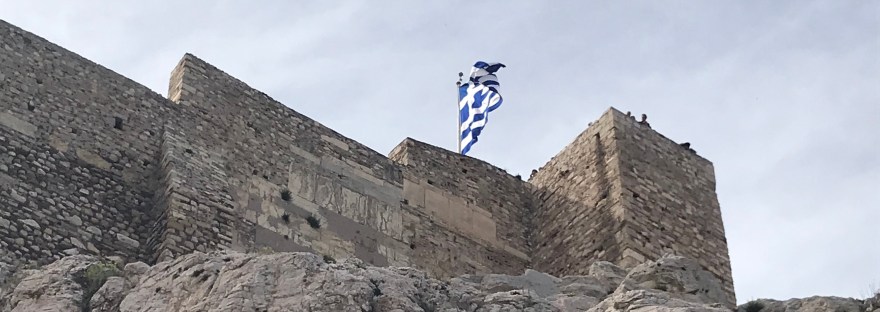
She died on 6 March 1994.  And for the last many years, museums and archaeological sites are free on this day or sometime this week. We went to the Benaki for free last week, in fact.  Last Sunday, March 4, entrance to the Acropolis was free, and though both boys have walked by, under and across many times, we realized they’d never been to the top. So off we went. It was a lovely Spring day and we walked and talked about the many myths about the Parthenon, the olive tree at the top, the various temples that used to stand there and how some brave youngsters climbed to the top in the middle of the night and replaced the Nazi flag with the Greek flag during World War II.  From there we walked down into Monasteraki and met Papou and Sandy for lunch outdoors.

This week we also visited Kerameikos, the ancient cemetery. The name comes from the greek word for pottery (like ceramic) and in ancient times was a community of vase painters and potters.  Some of this area was converted into a small cemetery which eventually grew into a large cemetery and a major ancient archaeological site.  There is a little museum on site that holds many burial artifacts from the excavations some of which date back to 2700 BC. It’s fascinating to see, just like art, how burials reflected the political evolution in Greece.  Places traditionally reserved for aristocrats were opened to ordinary citizens as democracy emerged. Historians learned a lot about Greek life and culture through the way people were buried.  It’s a nifty site that many tourists miss.  And – bonus – there were tons of turtles just hanging around.  It was awesome.

Next on our list was Plato’s Academy, a huge outdoor space in a now run-down Athens neighborhood.  Aristotle studied here before founding his own school.  It’s also on sacred ground for the goddess Athina, as her religious ‘cult’ was located here in ancient times. There’s a cool digital museum about Plato that looks like it’s made from storage containers — its design symbolizes the road to the light, and windows exist only in the entrance and exit of the building. Inside, you learn about Plato as a person, a philosopher, his travels and his writings. And there’s a copy of Demetri’s favorite painting of all time: Raphael’s “School of Athens.” The Academy grounds would be a perfect location for wellness retreats.  We pictured group yoga, horticultural therapy, meditation gardens and nature walks all year round.   Wonder how we can share this idea with the benefactor philanthropists from above?

And yes, the photo below of Papou and the kids is with a roasting lamb in the background.  It was boys night Saturday while the girls (Katerina, Anna, Sandy, me) went to the movies.

Greek life

The Benaki Museum

The Benaki Museum of Greek Culture is a jewel in the crown of Athens museums.  Located on Vassilis Sofia Avenue just up from  Syntagma Square and just down from the chic Kolonaki ‘hood, it’s a beautiful location with great views from the terrace.

The Benaki, as locals call it, is housed in the former Benakis (Μπενακησ) family home and is one of the most gorgeous neoclassical buildings in the city. It was converted to a museum to hold the art collection of Antonis Benakis and donated to the state by Antonis and his sisters around 1930. Named for their father, Emmanuel Benakis, the museum has a wonderful collection of items from ancient times to the 20th century.  Antonis worked hard until his death in 1954 to enrich the museum’s collection and to ensure its future financial security.

The collection is incredible.  The Greeks’ huge trade network and colonial expansion influenced life and culture as early as the 7th century BC.  Visits to the east (Phoenicia) added illustrations of sphynxes and griffins to their iconography.  Animals were added as well.  In the 5th century BC, when democracy began to emerge, various paintings (vases, cookware, etc) showed images of people … citizens.

One of the things we found fascinating is how the French revolution and its ideals of freedom, equality and fraternity inspired the Greek War of Independence.  This too is evident in various pieces.  And other, modern, masterpieces abound:  El Greco, Dionysos Solomos, and others. Plus costumes from various periods, parlor and salon recreations and a cool collection of Eleftherios Venizelos’ belongings in one corner of the museum, including a pair of his signature round glasses. Venizelos was prime minister of Greece eight times and is credited with being “the maker of modern Greece.” Emmanuel Benakis and Venizelos were close friends.

Post-revolution Greece saw a great deal of benefaction, a tradition that remains strong among Greek communities all over the word. The Benaki museum is a prime example of this.   Another interesting post-revolution outcome was the neoclassical movement — i.e., buildings like the Benaki were built all over the city, symbolic of the fresh start that Greece wanted so badly. Out with the oppressive Ottomans; in with the rebirth of Greece’s new capital city with an enlightened look and culture.  (Fun fact: as old and as important as Athens is, it was not the capital of Greece until after the revolution.  Michael loves to say “fun fact.”).

Neoclassical construction continued into the 1930s, but sadly World War II and the brutal German occupation, followed by the Greek civil war saw many of these buildings damaged and even torn down with the urbanization of Athens after the wars.

The nail in the coffin of neoclassic construction was legislation in the 50s that encouraged Athenians to hand over their family homes in exchange for multi-story, concrete apartments that would replace them.  There was so much migration from rural villages to Athens in the 60s and 70s that Athens and its suburbs became a kind of chaotic place that now holds about half of Greece’s entire population.

It’s sad to see these beautiful buildings downtown in such bad shape. While lots of these old mansions have been turned into museums, others just (barely) stand in state of disrepair.  There is an effort to preserve them, but the taxes are so high, it’s nearly impossible for average citizens to pay them.

The martis are doing their job: trees are blooming, I’m starting to smell cut grass on my morning runs, and Peter’s neck has turned a pale pink.  Two weekends ago we spent most of Saturday afternoon in the square with Thodoris, Mina, Anna, George and Little Katerina to celebrate Thodoris’ name day.  The kids scootered and played basketball and soccer, and the adults ate and drank coffee.  Saturday night, big Katerina, Sandy and I watched “La Boheme” live from the Met (NYC) at Megaro Mousiki, Athens’ lovely concert hall.  Much the same is planned for this weekend; looks like a sunny, warm weekend.  Ahhhhh.

The photo of the Benaki building above is courtesy of GreekReporter.com
Greek life

The March Bracelet

Kalo Mina! On every first of each month, Greeks bestow this wish on each other.  On the first of March, something else happens too. Peter came home yesterday with a bracelet on his wrist that Kyria Anna tied. He said his best pal Sylvia has two: she brought one from home and she got one at school.  Then, this morning, Kyria Soula, our school bus teacher and perhaps the kindest person I have met in all of Greece, put one on Michael’s arm and also gave one to me.

Kyrie Aleko, our funny, kind, awesome school bus driver, told me about this Greek spring custom.  March is widely considered to be the first month of Spring in Greece; everyone hopes March brings lots of wonderful sunshine.  And to protect themselves from being burned by this hot, Greek sun, Greeks, especially kids, wear the March Bracelet.

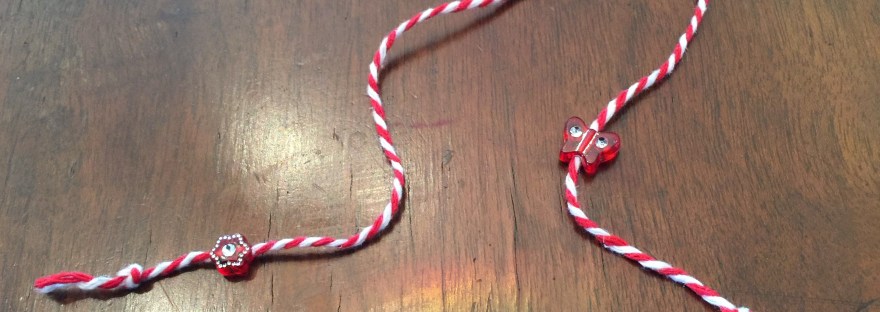
The “Marti” (the Greek word for the month of March is Μαρτιοσ) weaves red and white string together and may have an evil eye charm or other bling on it. Red is for life and passion; white is for purity.  The bracelet is to be worn from the first of March until you see the first birds returning from migration or the first blossoming tree, all celebrating the arrival of Spring.  This is a custom that dates back to ancient times.

How you say goodbye to the bracelet at the end of March varies. Some people hang them in fruit trees, so the trees remain healthy and bear lots of fruit.  Some people hang them in trees so the swallows can use the thread for their nests.

Tradition dictates that the bracelets be given as gifts; their powers work better this way.

Demetri and I saw a cherry tree in bloom in the chic downtown Kolonaki neighborhood yesterday.  But we are still going to wear our bracelets until the end of the month.

Καλο Μηνα!

Greek life

Clean Monday

Today is Clean Monday.  It marks the end of Carnival and the beginning of Lent in the Greek Orthodox Church.  It’s a ‘roaming’ holiday that falls on the 7th Monday before Pascha (Greek Easter), which this year is April 15.  For western Christianity, Easter is April 1.  It’s complicated why the two Easters fall on different days, but there are two basic reasons:

  • The Orthodox Church follows the Julian calendar and the Catholic and Protestant churches follow the Gregorian calendar. There is a 13 day difference between the two calendars.
  • The Orthodox Church adheres to the early Christian Church practices (First Ecumenical Council in 325) that require Easter fall after Passover in order to uphold the sequence in the Bible of the passion and death of Christ. Western churches do not always observe this so western Easter could fall before or during Passover.

Clean Monday is about ditching sin and non-fasting foods. The Sunday prior there are special church services in the name of forgiveness, so everyone can begin Lent with a clean conscience.  It’s customary to go to confession this week and to clean the house thoroughly.

Eating meat, eggs and dairy is forbidden to Orthodox Christians throughout the entire Lenten period.  Shellfish is permitted because it doesn’t have blood.  Traditional foods for today include taramosalata, a delicious, salty fish roe spread, gigantes, maroulosalata, a lettuce salad with simple vinaigrette, grilled octopus, boiled shrimp, calamari, and a bread called  lagana –pictured above — a oval-shaped flatbread covered in sesame seeds. You serve all this with ouzo and finish with halva – a candy of sorts made from tahini and sesame seeds; it comes from the arabic word for ‘sweet.’

The fun part of Clean Monday is that it’s a national holiday that celebrates the beginning of Spring.  The tradition goes back to ancient times when Greeks would celebrate the seasons’ change with worship and festivals dedicated to Dionysos, the god of wine and feasts.  It’s customary to fly kites.  So we did.  Papou bought kites last week for Valentine’s Day (boy are we mixing the US traditions with Greek ones) for Michael, Peter, Giorgos and Little Katerina.  Big Katerina came over this afternoon and we all went down to the beach and worked on our kite flying skills.  The wind was etsi-ketsi (so-so).  We’d get the kites airborne and sometimes they’d swoop right back down.  But it was fun and there were tons of people doing the same thing all along the Voula beaches.

The weekend has been beautiful. Saturday and Sunday were sunny; today is cloudy but not cold. We spent time Saturday in a great park in Glyfada riding scooters, ziplining, climbing and kicking a soccer ball.  Sunday we hung out in the square for the Apokries carnival where most kids were in costume.  Signs of summer re-emerged yesterday with the square full of bikes and scooters and tons of people.