Greek life

Christouyenna stin Ellada/Christmas in Greece

Christmas has arrived.  The pageantry is by far our most favorite part of the holiday season and Athens is more decorated than we expected in light of the financial problems.  We’ve watched the crews hang lights all over Voula and Vouliagmeni during our morning runs by the sea.  It does seem kind of odd to have Christmas lights on palm trees, but that’s likely just a lack of exposure (mine). They still look festive.

Last Friday (8 Dec), there was a celebration in the Voula square  — games and bubble tricks for the kids, a local choir singing carols in Greek and then the lighting of the square’s Christmas tree followed by … fireworks right over our heads! The square is very festive looking and lots of fun.  The boys found a friend from basketball and ran around with him for an hour or more.

In downtown Athens, the Attica department store has its windows decorated for the holidays, lights are strung across the streets and the tree in Syntagma square was lit this week.  We took the metro into Athens last weekend to get our city holiday on, and ended with a hot chocolate in the gorgeous lobby of the Grand Bretagne hotel.

It is full-on Christmas here — not ‘holidays’.  98% of the Greek population is Christian Orthodox, and even though the Greek State and the Orthodox Church are technically separated, the separation is not regulated and the Church has a lot of power in Greek society.  Greece spent hundreds of years occupied and controlled by Turks or Venetians or others and during those times, orthodoxy was something that defined Greek nationality. The church made great efforts to preserve Greek language, culture, traditions and the Orthodox faith. By preserving the faith, they also preserved the religious conscience and the feeling of affiliation.  So while it’s odd for Americans to see religious symbols in public buildings, schools, subway signs, the history behind it makes it more understandable.

The remaining 2%? More than half are Muslim and the rest are Catholics, Jews and Jehovah’s Witnesses. The Catholics are largely populated on Syros (it was the only Cycladic island never inhabited by the Turks — the Venetians had it), and there is a significant Jewish population in Thessaloniki, Greece’s 2nd largest city.

Greek orthodoxy celebrates Christmas a bit differently. Midnight mass on Christmas Eve and then Christmas Day is usually a family dinner of some sort.  The Greek version of Santa, Agios Vasilis/St. Basil the Great, brings gifts on New Year’s Eve.  This makes the boys’ heads spin.  Will Santa find them on Christmas or will Ag. Vasilis come instead a week later?  Frankie, our elf, managed to find us. Complicating the matter is that we will not be in Greece for Christmas or St. Vasilis Day, so what does THAT mean?  We’ll just have to see what happens….

Our school held their Christmas Bazaar last night, 15 December.  There was an entire classroom for cookies and sweets, and the upper school was walking around auctioning off dozens of full cakes and loaves of tsoureki.  Each class was in the gym selling their Christmas crafts. We came home with little goodies which is terrific as we don’t have many decorations.

The Nipiagogeio (kindergarten) held a play titled “Who Kidnapped Agios Vasillis?” about, you guessed it, the kidnapping of Santa.  Over the years, Agios Vasillis has morphed into “the Greek Santa,” likely out of commercialization.  In reality, Agios Vasillis is a tallish, skinnyish fellow with a long beard who comes from the east.  His story is similar to that of St. Nicholas, who helped the poor and needy.  He died on January 1, 379 AD and the orthodox church celebrates his name day then.

The play was hilarious. The kidnappers, the head elf, and Santa were all played by teachers. Peter had two roles, one as a kid affected by the kidnapping, and one as an evil scientist who was on a team of interrogators with Santa in captivity.  He had 4-5 speaking parts, all but one in Greek.  We all cracked up when he asked Santa just exactly how he gets down the chimney.  (“πωσ περνασ μεσα απο ‘κι καμιναδεσ?”) Sounded like a native speaker. And he winked at us a few times from the stage.

In other Peter news, we went to the doctor one evening this week for coughs and pink eye.  The next day, Demetri got a call from Peter’s teacher asking if Peter indeed went to the doctor because he swallowed a fly and it laid eggs in his throat.  Demetri assured her that only the first part of the story was true and explained how we are really working on our imaginations in our nighttime storytelling.

We absolutely love all the cards we’re getting from our friends and family. Thank you all so much for thinking of us and sending them all the way to Greece.

Kala Christouyenna! Kales Giortes!


Greek life

TGIP

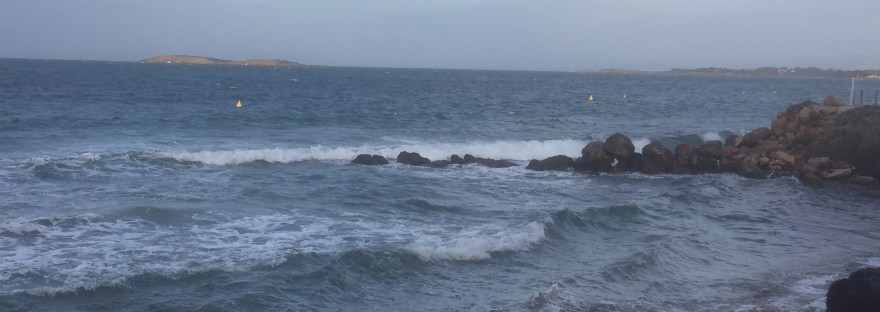
Friday – Paraskevi –  is the kids’ favorite day of the week. Isn’t it everyone’s?  As I sit watching the two-tone sea on this windy, cloudy but warm afternoon, I’m glad it’s Friday too.  The Christmas tree in the Plateia is being lit tonight, Demetri’s coming home tomorrow after a week in Portugal (his FB pics are great – go look), we’ll see Anna, Vasillis and the kids this weekend, and both Michael and Peter have a laser tag birthday party on Sunday.  Quick aside: birthday parties are basically the same here as in the US, except the venue has a professional photographer to take photos of each child and then of course you can buy the photo or some swag that goes with it.  I thought it was brilliant …  and the moms laughed at me saying just wait until you have 15 key chains. By Sunday I’ll have 4.

We’re two and a half months into school and both boys are doing so well.  Their school takes great advantage of the culture in and around Athens.  Peter’s class went to the Wizard of Oz this week and last week they went to an olive orchard to harvest olives from the trees and began curing them. He’s also been to two theater performances.  Michael has been to the ceramics museum in Athens and 2 theater performances, and both boys got to skip out of school at 12:30 on Halloween to go with the school basketball team to the SEF basketball stadium where the Olympiacos team plays.  There are two more field trips each before school breaks for Christmas.

Plus, they’re having fun.  Peter’s class is small and he has special things to say about each child.  Sometimes he compares them one for one to his buddies from PreK,  and his most consistent bubble up each day is when he gets to play with his friend Demetri in school.  But he also loves to play with Ermes, Fillipos, Chrysanthi, Anastasia, Gianni, Massimo, Dorothea, Kacey, Ais, Sylvia … he loves them all and Kyria Anna too, his wonderful teacher.  She’s pretty amazing. He is learning Greek well, he understands a ton, knows a lot of words, all the parts of the body in Greek, and is always singing or humming a Greek song.  Having never met a stranger, Peter recognizes kids in the square from school or from the bus and yells “Gia sou Giorgos!” (or Panos or whomever) across the way.  He has a little man crush on Spiros, a 5th grader who lives around the block.  Spiros is quite cool.  And very kind.  Kindergarten here is not as rigorous as Aspen, but going to school in a foreign country where you don’t know the language is more than enough rigor for one little person.

Michael is mildly obsessed with basketball and loves going to practice.  Sweet Papou got him a hoop for his birthday and he shoots almost every morning as we wait for the bus.  He loves drama and computers and he has fun in English class where he’s got his buddy Max (Max speaks 4 languages) and 3 other second graders who are bilingual.  Max has been his pal since day one, along with two sisters from Australia who are in our same boat with the language.  One of the girls works with Michael and Ms. Elena every day.  And just in the last week, he’s been starting to play with his classmates more and more, which has my mommy heart exploding.

Of all of us, Michael’s had the biggest challenge with the language.  For Peter, it’s fine that he’s not fluent.  For Demetri and me, it’s fine too.  Most everything (signs, subway announcements) is translated and everyone speaks some English.  Peter can be in class without having to know how to read or write at this point. But in second grade, you are listening and learning in Greek only.  That part was addressed by school early on and the solution is working great.  The social piece has been more difficult.  He would come home with stories of boys getting in his face, not letting him have turns, knocking his ball out of his hands, pulling the door shut when Michael was coming in, and Michael was frustrated to not understand what they said and not to be able to tell them to stop. Then one day one of these boys pinned him between one of the desks and the window.  Demetri, who went to 4 new schools between kinder and 5th grade, had excellent counsel for Michael. He constantly reminds him that what he’s doing is hard, that it is okay to say stop in English, and that part of what makes it difficult is that we don’t understand how other kids play.  (School said that the desk incident was just playing, but that also they believed Michael that he didn’t think so.)  Demetri never told Michael to push back or get back in their faces, but to engage and be fun about it, disarm the behavior.  So, one day Michael got off the bus thrilled to tell us that when one of the two boys got in Michael’s face and growled at him, Michael growled back and then smiled at him.  Then Michael went back to what he was doing.  The next morning, this boy was waiting for Michael when he got off the bus and that day he and Max played with lots of other second grade boys at recess … and have been ever since.  Major breakthrough.

I didn’t write all this for anyone to feel sorry or sad. Many of my friends have been through this or worse and I know it’s part of being a kid and being a parent.  This blog was intended to be part travelogue and part family journal and today is a journal entry.  But more than that, I wrote it for Michael’s (or Peter’s) future self. Seek first to understand, right?

A few photos from the last couple of weeks are below.

Greek life, Travels

Χιοσ

Chios (Χιοσ), is Greece’s fifth largest island.  Situated in the north Aegan, Turkey is just eight nautical miles away.  It’s the birthplace of Homer.  It’s probably the birthplace of Christopher Columbus. Its history goes back to the Neolithic period and Chios’ claim to fame is its mastic trees.

Most of the Greek islands (e.g., Syros, Milos, Skiathos, Hydra) are a summer destination for most of Greece and half of Europe.  They are insanely fun, busy and crowded until September when they essentially close up until the following May.  Some islands, like  Chios, have a thriving agricultural base, and are busy, productive islands with year-round inhabitants. That was the draw last week when Demetri and Papou spent three days here.

Chios was conquered by the Genovese.  The village of  Kampos has many 13th century mansions that each had huge walled orchards for citrus fruits. Lots of these farmers came to the US in the 19th and 20th centuries and started citrus orchards in Florida, then returned to Greece after building their fortunes.

The island has an interesting history regarding the Genovese control. Chios was a republic of Genoa (invaded and settled by them) and there is a lot of evidence that the island is most likely the birthplace of Christopher Columbus, as many various documents from/about him say “republic of Genoa” and not city of Genoa, which is in Italy.  The Columbus (Kolombos) family name in Chios goes back 700 years and there’s a house marked as his birthplace.  There’s a lot of controversy around his origin and there are a lot of books written about where indeed Columbus was from with significant evidence that he was not the son of an Italian wool farmer.  Most interesting is that Columbus kept 2 logs – one fake and one real.  The ‘real’ one, which has been used to verify his discovery of San Salvador and to clear up discrepancies about it, was written in Greek.  The ‘fake’ one was written in Italian. Matt Barrett, a prolific Greece travel writer, reviews a book on his website that he believes answers the question about Columbus once and for all.  It’s a fun read.

Chios mastic is produced on the south side of the island by 24 villages. It’s been harvested for almost 3000 years. Hippocrates used it to treat colds, bad breath and to prevent digestive issues. It’s still used in gum, cosmetics, pastries and liquers — the drink has a wonderful woody, pine smell.  We enjoyed it in Milos many evenings this summer. In 2014, we enjoyed it as a spoon sweet after lunch in Kalamata.

Mastic sap drips from the trees and forms little teardrops.   The drops are hard, but they soften as you chew. Mastic was a great source of wealth for hundreds of years. Everyone wanted it – Venetians, Genovese, Turks.  During Ottoman rule, the penalty for stealing it was execution.  Oh, and Columbus was known to patch his boats with mastic.  Ahem.

There’s a cool Byzantine village called Anavatos, which translates to ‘you can’t walk up here’.  Now that the place is in ruins, it was easier to explore than a few hundred years ago.  In 1822, nearly 75% of the island’s population was killed in a battle against the Turks during the War of Independence; much of the battle took place near this village.

One of the best parts of island travel is the local food and learning what influences their cooking.  One afternoon, it was too late for lunch and too early for dinner.  Papou and Demetri stopped in a little town and found an ouzereia — a little cafe with mezetes, ouzo and coffee. There were 7 men sitting there with ouzo and coffee, not speaking to each other. They were all watching some sort of reality fashion show on television.  The owner had just made a cheese pie.  Cheese pies in any form are delightful. Fresh cheese pies are phenomenal.

They found an excellent restaurant in Chios town and ate there both nights.  They had fazolia, cannelini beans in tomato sauce with local mandarin oranges and it was fantastic.  The soutzoukakia, traditional meatballs in tomato sauce, had some turkish influences with cumin.  Also excellent.  Stifado, historically made with rabbit, is braised beef cooked for hours.  This restaurant made it with chestnuts (which have just come into season) and it was the best thing they’ve eaten in weeks.


Greek life

17 November

Greece was a mess after World War II. The Germans occupied Greece from 1940 until the war ended in 1944.  From 1944 to 1949, Greece was in a civil war basically over communism. It was early in the Cold War — British and Americans were trying to contain communism; Russia was trying to expand.

The 1950s economy was pretty bad.  Thousands of people died from famine during and as a result of WW II; thousands more died during the civil war.  As a result, people were leaving the country in huge numbers. Things started to get better in the 60s with upticks in construction, tourism and manufacturing, some say thanks to western influences.

Greek modern political history is like a tennis match.  A monarchy was established in 1832 after the War of Independence.  It got rid of the monarchy in 1924 and restored it again in 1935.  In 1936, the king appointed Ioannis Metaxas (the one who said “Oxi“) prime minister; he was a fascist with a right wing regime; he died in 1941. In 1952, a new constitution declared Greece a parliamentary democracy.

In 1967, a group of military officers seized power and until 1973 Greece was being run by a military dictatorship called the Regime of the Colonels or the Junta.  Elections were called off indefinitely, civil rights pretty much vanished, politicians were jailed for their beliefs but oddly enough the economy did pretty well. The US and other western powers supported the Junta; anything to prevent the spread of communism. A fairly strong anti-American sentiment still remains with some Greeks.

Said all that to talk about November 1973.

On November 14, students at the Athens Polytechnic University (Polytechneio) began gathering to protest and demonstrate against the Junta.  Citizens from Athens and other parts of the country joined the students to demonstrate.  The government assembled military equipment and police in order to stop the demonstrations and sent a tank crashing through the gates of the university to crush the revolt.  24 people died; shot by military police.  Close to 200 more were injured.

This uprising is widely held as the beginning of the end of the Junta.  In 1974, after a counter- coup (maybe 2), the military dictatorship collapsed and a a parliamentary republic was established.  That’s what Greece has today.

As a result of the 17 November uprising, an ‘academic asylum’ law was put into place, banning police entry of any kind onto college campuses no matter what.  The law was abolished in 2011 after people took advantage of the law for protests against Greece’s austerity measures.

November 17 is a holiday for all educational institutions in Greece — from preschool through the university level.  Most schools hold some sort of memorial in honor of the day — our school holds theirs the day before so the 17 November can remain a holiday.

Greek life, Travels

Kalavryta

Kalavryta is a ski town in the central Peloponnese, with a lovely square, nice bakeries and restaurants and cute houses and buildings.  It was under Turkish rule from the mid 1400s on, with the exception of a 30 year Venetian occupation.  Kalavryta, specifically the Agia Lavra monastery just outside the town, is where the Greek Revolution launched in 1821.

It’s also the site of a horrific Nazi massacre of the second world war.  In December 1943, 80 German soldiers were captured and held prisoner by Greek resistance fighters.  Most were executed; the few who survived got word to the Nazis, who sent troops to this quiet little town for retribution.  On December 13, the Nazis separated males 12 and older from women and children.  More than 600 men were taken to a field and executed by machine gun. Fewer than 15 survived.  The Nazis placed the women and children in the school house and set it on fire.  They managed to escape, though much of the city caught fire after that, and the Nazis burned what was left the following day.  Two victims of the massacre were named Fefes — they were cousins and great uncles of Papou’s.   The memorials to this tragedy are unbearably sad, especially a sculpture of a woman and her two children dragging her husband out of the field.  Names of the dead are inscribed on the memorial that sits above the town; every year on 13 December, the city reads the names of the victims.

About 15 kilometers outside of Kalavryta is the very cool “Cave of the Lakes.”  Several different fossils — including a hippopotamus — have been found in these caves that were discovered in 1964.  50 different bat species make their home here.  The path through the caves is on a metal suspension bridge, as from November to March, the caves fill with water and have a bunch of natural waterfalls. At one point at the far end of the caves, there is a stalagmite (ground up) that connects to a stalactite (ceiling down), which is very rare.  One centimeter of rock takes 100 years to form.  Cameras aren’t allowed.

We ate well (again!) in these pretty mountain villages.  At one point, Peter finished a bite and sighed, “boy I love lamb.’  It’s especially good cooked for hours in the oven with lemon and oregano.  Kokoras (rooster) with tomato sauce and red wine is fantastic & served with a huge side of spaghetti, much to Michael’s delight.  One taverna’s specialty was a hortapitaki — sauteed or boiled greens with dill and some local cheese baked into a phyllo.

In other news, there is a suicidal bird that keeps flying into our apartment.  Demetri and Papou are out of town for a few days so I’ll be camped out in the bathroom.