Greek life

Glorious October: the first two weeks

The beginning of this month has been completely gorgeous – days are sunny and in the mid-to high-70s, mornings and evenings are in the 60s.  We’ve been taking advantage of these beautiful days to explore the area on foot and by car.

The first Friday of October, I went downtown with Papou.  Our main destination was the Megaro Mousikis, Athens’ concert hall.  Built 26 years ago, it sits on the pretty Vassilis (Queen) Sophia Avenue. Megaro Mousikis holds concerts, operas, ballets, and even conferences. We were headed there because Papou treated Demetri and me to see Norma live from the Metropolitan in New York, and he’ll babysit the kids while we have an evening out. In the history of babysitting, I’m not sure if there’s ever been someone who watches your kids for free and pays for the parents’ activity.  Best guy ever.  Norma is a Bellini opera; the lead role was made most famous by Maria Callas, Greece’s pride and joy. It’s Papou’s favorite.

While we were there, Papou also bought ballet tickets for later in the month – Sandy is in the US for a stretch, so Katerina will go with him.  With two sets of tickets in hand, we left the music hall and walked next door to a beautiful garden café nestled under a bunch of trees – a quiet little gem in the loud city.  The café is famous (at least to us, Katerina and Papou) for its tyropita; a cheese pie made with four different cheeses and baked in kataifi dough, which is very delicate and looks like thread.  After we finished, we wandered past the palace, the American school of Archaeology and through the Kolonaki neighborhood to the funicular that goes to the top of Lycabettus (say leh-kah-vi-tos) Hill that sits 900 fit above the city.  Because ancient Greek life centered around the Acropolis and Philopappos, it seems not much is known about Lycabettus.  Mythological tales say that Athena dropped the rock here by accident when she was creating the Acropolis. Regardless, from the top you can see all of Athens, the surrounding mountains and and all the way to the Aegan.  At the top is a church for St. George, a bar, a tavern and a coffee house. We had a coffee, came down and walked back to the metro along Panapestimio Street. I showed Papou my favorite shoe store; he showed me many more important buildings — Parliament, the Prime Minister’s office, the Benaki Museum.

Saturday, we met some new friends, Theordora and her son Ermis, at the Stavros Niarchos Cultural Center (SNCC), a brand new building that opened last year.  Niarchos was a shipping tycoon; in the early 1950s he built the largest tankers (ever) for his fleet. The demand for oil in the 50s and 60s is what made billionaires out of Niarchos and his rival Aristotle Onassis. Both families now have large philanthropic organizations that do charitable work around Greece – in fact, the Niarchos Foundation was the major grantor for the jeweler residency program at the Elias Lalaounis museum.  The SNCC is absolutely gorgeous.  The complex hosts the national library and a museum, but it’s also got beautiful grounds with paths and trees and picnic areas, a labyrinth for kids to explore, giant chess boards, bike rentals for kids and adults, and a terrific view from the top.  Even the parking is super slick.  The boys played football (soccer) and chess (skaki), cruised around the labyrinth, we all went up to the viewing tower and left just as the rain started.   Demetri and I left for the Opera soon after getting home, while Papou was prepping pizza AND spaghetti for the boys.

Sunday was the icing on the weekend cake – family lunch at Anna’s house.  There were 10 of us – we four, Anna, Vasillis, George and little Katerina, and Theodoris and Mina.  (Anna and Theodoris are Demetri’s cousins; their grandmother is Papou’s sister).  Anna’s meal was fabulous and we all had so much fun – I just love these four kids together.  Little Katerina was my best Greek tutor yet; she taught me all the parts of the body as demonstrated on Elsa and Olaf.

The following Wednesday, October 11, Demetri left Greek class to meet his dad and some of Papou’s college friends from the University of Michigan. They spent the afternoon in a Taverna in Monasteraki, the ‘flea market’ neighborhood of Athens.  It’s a major tourist attraction – if you’ve even gotten an evil eye charm, a pretty, wrapped olive oil soap, a Greece magnet or an Olympiakos jersey, it probably was bought right here.  They ate well and told stories of the Michigan days – both in Ann Arbor and Detroit, where they all lived after graduation.  Demetri and Michael were born in Michigan and all these friends knew him as a baby.

Both kids had field trips this week to theaters — their school does nifty excursions and there’s so much to take advantage of here.

We topped off the first half of October with a super weekend away … the next post tells you all about it.
Greek life

Πώς είναι το σχολείο?

Today’s headline translates to “how’s school?” And to that, we say, pretty darn good. (And thanks for asking!).

The kids are a month into their Greek school.  They have some friends, they’re playing Basket(ball) and they swim twice a week as an extracurricular activity but it’s during the school day.  They love riding the bus, eating lunch outside and computer class, and this week each had a field trip.

Peter is picking up Greek quite well.  The other day I asked him to come to me and he responded in Greek.  The child always has a song in his head and lately they seem to be little Greek songs he’s learned in school.  His pronunciation is near-perfect … he says his friends’ names with all the right accents and the exact right letter sounds.  He also hollars “pou pas?!” (where are you going?!) at passing drivers who go too fast and “fige” (scram) at anyone bothering him.

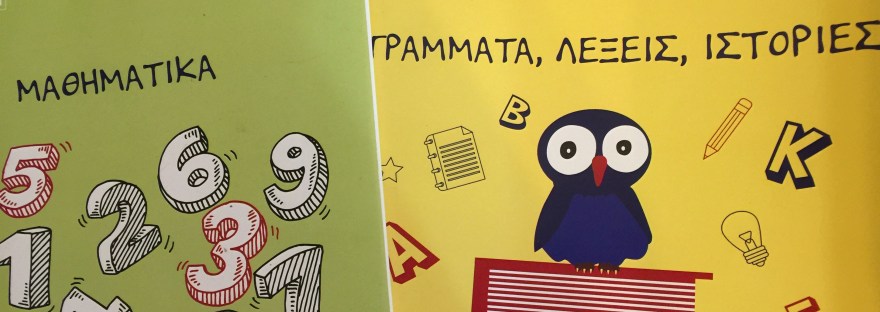
Michael’s work is more difficult, but he works hard and rarely complains.  He’s got at least an hour and half of homework a night for Greek language — spelling, reading, writing — and this is after three hours of it in school.  He’s also got math and English homework most nights too. His penmanship is quite handsome and he does a nice job forming his letters.  He seems not to be confused by them like I am.  It was very interesting watching him start to learn — Kyria Elena taught him all the letter sounds and how to read words before he learned any of alphabet or the names of the letters. Within a couple of days he had all the lsounds and all of the accents down and was reading like a champ — Elena said it didn’t matter that he didn’t know the meanings of the words, it was more important that he could sound them out.  The alphabet came this week along with verb declinations.  More on verbs later.  He is quite proud this week for being given a ‘student of the week’ badge in English.  And math is just fine — most of what they’re doing now are things he learned in first grade; the challenge of course is that the directions and problems are all in Greek.  But between Google translate, Papou and Kyria Mamika’s explanations before he leaves school, it’s going just fine.

Demetri and I started Greek language school October 2.  We’re commuting to Maroussi, a city on the north side of Athens. It’s a hike — about 90 minutes by train.  But, we have the time, we get to be together and it’s fun watching all the Athenian commuters negotiate the Metro and the busy downtown stations.  Demetri has taken two intensive language courses with this school — both in the summer on Greek islands — and he really enjoyed the teaching staff and how they approach the language.  I feel το ίδιο, the same.  I’m the only American in a class of 5 and all of the others speak at least two languages, so I feel like a total slacker. Demetri is in the advanced class and he’s got private lessons.

Greek isn’t easy.  The alphabet is confusing. In July, I asked Demetri what sound the o with the feet (Ω) makes. All of you who went to large universities with fraternities and sororities are already ahead of me because you likely know the alphabet.   I had to start there … and I used toddler letter books to semi-teach myself the alphabet over the summer.  Papou helped.  I wrote down expressions phonetically (in English) that I used often but now that I’m in school I can see that something I thought was one word is actually three.  Demetri is experiencing the same thing with things he’s known how to say all his life.  Keeping the letters straight (there are 5 letters or letter combinations for the long ‘e’ sound, for example) is one thing, and the verb declinations are something else entirely. Papou tells me that you don’t have to use pronouns because the verb’s ending tells you what the person and tense is.  Kostas, my Greek teacher, says the same about pronouns being extraneous.  But Kyria Elena is teaching Michael the verbs with the pronouns, which makes sense for overall knowledge.  Michael and I have been working this week on conjugating ‘be’ and ‘have.’ He also got some kid-typical verbs like cut, run and play, and I’m working on drink, do and live.  Demetri wins the verb prize — he’s stuck in conjugation hell. While Michael and I are working on present tense only, Demetri is in past, future, present, past perfect, future perfect … and so on. He says the more he learns the more he realizes he doesn’t know.  His class notes have mostly Greek letters with notes to himself in English.  I haven’t been able to switch my brain to think in Greek (and I don’t know enough) so my notes are Greeklish – Latin letters to make Greek sounds.

I have always giggled at the word ‘Greeklish.’  I tend to use it when I use the greek word I know and the rest in English (“Kalimera, may I please have dio koulouri with tyriGia sas. Tha ithala chocolate milkshake?”).  But it also means using the Latin alphabet in Greek words, like in my notes from class.  This habit, being employed by a lot of young people in general, is becoming a big problem.  They’re choosing not to spell correctly and it’s ending up bastardizing the language.  So a word might end with an η (ita) but that letter is replaced by an ι (iota — it’s an i but there’s no dot, which as an aside, is THE hardest habit for me to break) in a text or an email.  You have to know how to spell to get the whole language right — because if you don’t know Vouliagmeni actually ends in an η (Βουλιαγμένη), you’ll have the wrong article in front of it and it looks neutral but it’s really feminine.  I forgot to mention all nouns have genders too.

Some say that Greece will eventually move to a Latin alphabet. Turkey has. Demetri is seeing movement already in articles and publications where the Latin ‘m’ is being used instead of μ, but I’m sure it will be many years before Greece lets go of its alphabet that was invented in 800 BC.

But, it’s fun to be learning it.  I attempted to read an email from school today before automatically pasting it into Google translate.  Not there yet.  I still predict Michael and Peter will be speaking it with ease by Christmas.


Greek life, Travels

Hydra

I read an article not long ago that referred to the island of Hydra (say “ee-dthra”) as ‘Greece’s Nantucket.’  No cars, taxis, scooters, motorcycles allowed; transportation is on foot or mule. It is f-u-l-l of cats.  Aside from a skid steer here or there for building renovations, the only vehicle on the island is the garbage truck.  The no-car rule has has kept heavy construction and development very low and makes Hydra feel remote and far from anything — even though the Peloponnese is just across a narrow strip of water. There are no resorts or other large hotels, just quaint little hotels and B&Bs, many of which are former mansions.

Hydra played a prominent role in the Greek War of Independence, which began in 1821. Several island residents, many of whom were naval officers, formed a secret revolution society and raised significant funds for the rebellion.  During the war, Hydra was the focal point of the Greek navy.  In 1830, after several years of fierce battles, England, France and Russia forced the Ottomans to recognize the Greek independent state.

We’d been planning to visit Hydra sometime in September, and finally made it last weekend. Summer is basically over, but the islands are still lovely enough to enjoy what we Coloradans call ‘shoulder season.’ Demetri has been here three times: once as a kid, once in 2010 with Tyler and last weekend with us.  Hydra summers are super hot; relief comes from a high jump off a huge rock into the turquoise water below.

We stayed in a sweet little hotel near the harbor, where the owners made breakfast for us each morning: omelettes, crepes, yogurt, fresh bread and homemade peach marmalade. We had dinners in little tavernas situated beneath bougainvillea and Sunday lunch in a ψσαροταβερνα (psarotaverna – fish tavern) overlooking the ocean.  There was a large family table next to us with three guitar players and they had much of the restaurant singing along.

The patron saint of the island is St. Konstantinos, an 18th century saint who was born on Hydra but spent much of his life in Rhodes, not knowing that been secretly converted to Islam and and had his name changed by the Turks. We hiked up to the church and monastery named for him on our way up to another monastery at the top of the mountain.  Thanks to increasing ecotourism, many towns, islands and villages throughout Greece have revived the (very) old goat herder trails and marked them for hiking and walking.  The paths take you through forests, over mountains, into valleys, and now since they’re marked, you can be confident instead of hopeful that you’ll make it to your destination and back.

We followed the square yellow tags to the monstery of Profitis Ilias — three steep miles uphill with spectacular views the whole way. We met a nice couple from Brooklyn about halfway up and walked with them for a bit.  Michael, our little mountain goat, seems to get more energy with every step no matter where we are hiking. He zipped up the mountain, smoking the rest of us per usual. Peter won the trooper award that day, walking the whole thing and never once asking to be carried.

At the top, Demetri explained to the boys that the priests who live here have a very quiet life of service and we needed to be respectful and quiet also, maybe even silent, as the men who lived here most likely never speak. At that moment, a priest came through the gate wearing a fleece jacket, new Nikes and talking on his smart phone.

While Demetri and Michael walked into the church and lit a candle for Uncle Michael, Peter and I stood outside to look at the mules who had shuttled some folks up the hill. Peter turned to me, pointed to the priest with the smart phone, and said, “that man looks exactly like the god in my brain. His hat, and his beard and his clothes are exactly the same.  How about the god in your brain, mommy?  What does he or she look like?”

I was speechless.  I stared at him for a few seconds before answering his question. I am constantly awed by how children’s brains work — so innocent, so genuine, so logical that as the adults we can see how the thought started and how their question or comment formed. This thoughtful rumination from a five year old tops the list maybe forever. I had to write it here so I never forget it.

We left on the 4:45 ferry Sunday; Papou was standing at the dock in open-arm hug stance to take us home. When he asked the boys what they liked best, they talked about the 4 kittens we met living under a house they named Fluffy, Sweetie, Patches and Orange Julius (Demetri’s hilarious contribution.)  Hydra is a must see.  Even though Monday morning came fast and early, Michael said the weekend was nice and long.  That’s just how you want to feel when you’re climbing out of bed to start the week.


Greek life

Car saga, continued

Our prediction of a paperwork problem with the car came true.  Demetri got a call from the dealer one morning this week telling him his name can’t be on the title unless we pay an “Expediter” €125 to handle this under the table.  In other words, our national visa issued by the Greek government is inadequate for a car title, we must have a green card.  But with the  €125 ‘fee’ (known locally as fakelaki), we can have the car in our name.

This is not our first experience with the fakelaki issue.  We bought two Stand Up Paddleboards before we left the US and had them shipped to Athens.  When Papou went to retrieve them before we arrived, he was told there was a €500 fee to get them out of customs. 500 euros is almost the cost of one SUP. Surely they were joking.  Papou did not pay; the boards were safely stored until we arrived and could straighten out this silliness.

Turns out the silliness was ours. Let me back up: Fakelaki translates to “little envelope.”  It is the term for bribery of government or private companies by Greek citizens to ‘expedite’ service.  I’ve heard it compared to a gratuity (e.g., slipping a  $20 to the maitre d’ to get moved to the top of a wait list at your favorite trendy restaurant), but it can also mean a specific tariff demanded by government officials in order to bypass procedure.  The dealership manager explained that the Greek system is so bloated, the fakelaki ‘greases the wheels’ to move things along.  

Back in July, if we wanted the SUPs, we had to pay the fakelaki.  Simple as that.  And, it had to be cash.  So, we’re paying it because Customs told us we had to, yet the cash never made it to the government.  There was no paperwork or receipt.  The same was true for the car title.  While it sounded very official, when Demetri tried to pay the €125 by credit card, the dealership manager said, “Signomi, sir, cash only.”   The conversation ensued as follows:

Demetri: “So, I won’t have legal title if I don’t pay the expediter? And in this case, YOU are the expediter?”

Dealership manager: “Right and yes.”

Demetri: “But the title will be legal if I pay this cash fakelaki?”

Dealership manager: “Yes.”

Demetri: “And what happens if someone does a search for the title? Whose name will it be in?”

Dealership manager: “The database will return a result that says the title is ‘lost in the ministry.'”

Demetri: “And that is a legal answer?”

Dealership manager: “Yes.”

Demetri: “What happens when I sell the car?”

Dealership manager: “The title search result will say ‘lost in the ministry’ and someone else will be able to buy the car. Kanena provlima (no problem).”

Demetri: “Ok. So, I have this cash, do I need an actual envelope?”

Dealership manager: “No, you can just hand it to me.”

This car dealership is the European equivalent of CarMax in the US.  It’s headquartered in Austria.  It’s financial center is in Brussels.  The car was shipped from France. This isn’t some dude in his garage selling stolen cars to fuel his drug habit. This is standard procedure in Greece for a multi-national European company.

I agonized over how to explain the fakelaki in writing.  How could I clearly articulate it in a way that truly explained what it is and that it really is a thing? To me, and perhaps to you,  ‘under the table’ means unspoken, illicit, I-know-a-guy.  It’s an old world practice.  Oh, not so.  Fakelaki is so much a part of Greek society, the term has its own wikipedia page.

It gets funnier.  Yesterday, the insurance guy called to get some info and to give Demetri some ‘good news’ — they didn’t need the full fakelaki for the title, so the insurance guy can apply €50 of it to the insurance premium.  Isn’t that great?!?

The fakelaki practice goes back to the Turkish occupation.  It’s old world corruption, but it remains the national way of doing business.  Some argue that fakelaki is a large part of why Greece has never had a thriving economy. And until this practice is over, not likely in my lifetime, Greece will remain at the mercy of its creditors.

The dealership manager called.  The car is ready.


Greek life

The car story

In July, we bought the coolest, most adorable Alfa Romeo Giulietta.  It was as beautiful as all  Italian things are — color, design, nifty little extras, hidden back door handles, a fast engine with good horsepower. Leave it to the Italians to give your car a pretty name so you don’t have to think of one. It took us 5 days to be able to test drive it because the keys were locked in this super-secure, state of the art lockbox, and only one guy had the key.  Said fellow was on holiday.  Most of the keys for the cars on the lot were in this box, so I guess, despite five people on the clock at the dealership, they weren’t planning to sell any cars until his return, which was 10 days away.  In the meantime, Demetri went downtown to get what is essentially a Tax ID number so all taxes on the car could be paid properly and expeditiously. Smooth as butter.  Insurance was purchased.  No problem.  At the last minute, and I don’t recall why, there were paperwork problems.  Papou rescued us; Demetri picked up the car.  We went for a lovely drive that evening down the coast.  We had visions of road trips to the Peloponnese, to northern Greece, heck, maybe even to France.  The next morning it would not start.  At all.  We jumped it.  Surely it just needed to be driven a bit.  We went to IKEA.  It wouldn’t start.  Papou rescued us. (Anyone sensing a theme?)  We drove almost an hour to Marathon for George’s 7th birthday party. Surely a long drive would fix the issue.  It didn’t start.

We returned the car the following day.  And then we went on a couple of vacations  (Peloponnese and Rodos) in rental cars and put the car off until school started. We became intermediate experts of the public transportation system – bus, tram, metro, and Taxibeat, which is basically Uber for cabs. And we borrowed Papou’s car a few times also.

The boys still scream “GUILIETTA!” with great delight every time we pass one.

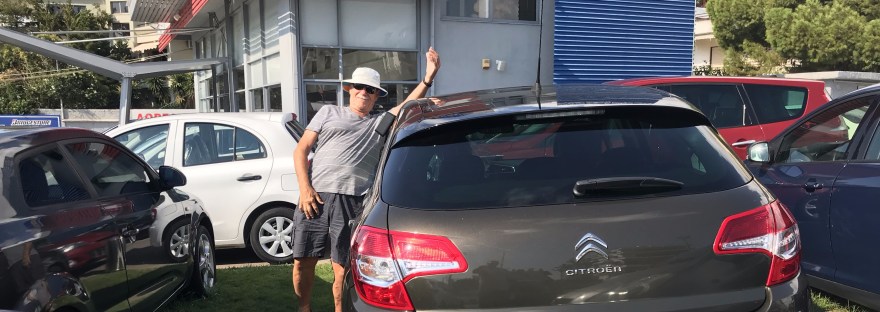
Two months later, i.e., this week, Demetri, weary of online car research and the debates in his own head (how old is too old? a tiny car is good for parking and ferries; a larger car will protect us all better.  Diesel might be easier to resell because of the cost of gas), he went to test drive three cars that had risen to the top of his long, detailed spreadsheet.  He came back having purchased one of them — a Citroen that is small enough to park, large enough to protect us in a crash, an efficient engine that has some power to get up the Greek mountains, new enough to have some decent technology, old enough to justify the cost.  The color is ‘cafe.’  How quintessentially, adorably French.

We remain optimistic despite having been here before.  The good news is that all of the car keys were accessible and test driving was no problem.  A new battery & full check-up is guaranteed.  Paperwork seemed to go smoothly, though we are expecting some sort of paperwork crisis in a few days just because it’s how Greeks roll. (Last time it was that we didn’t have Greek ID, except we do — our visas — but it’s not acceptable even though it’s official or something.  We are still confused about that.)   Papou will (say it with me) rescue us if that happens again. So, a few more days and we expect to have wheels.

About that: it takes a week or so between purchase and possession.  Unlike the US, the license plate is assigned to the car for its life, rather than being assigned to the driver. That means the dealership handles getting the plates assigned to you and all of the other DMV-like tasks, but that process doesn’t move quickly.

I hope writing about it doesn’t jinx it. On the other hand, the story will get even funnier with another chapter.