Greek life, Travels

Rhodes, part 2

Rhodes has beautiful beaches; we visited three during our stay: Tsampikas, Traganou and Anthony Quinn. Quinn filmed “Guns of Navaronne” in Rhodes and loved Greece very much. (“Zorba the Greek” was filmed on the island of Crete).  He wanted to buy three parcels of land right above the cove of the beach that now bears his name; the middle one was owned by the state and they promised to sell it to him.  They reneged, despite the fact that Quinn had already paid for significant water and power infrastructure to the area.  The beach is gorgeous; easy to see why he chose here.  Tsampikas and Traganou were large, organized beaches (chairs, umbrellas, snack bar) and both had nifty rocks for jumping and caves for exploring.  We had the SUPs with us and we took turns paddling around.

With six mild sunburns (everyone except Michael), we spent a day out of the sun to explore. We started our day at the Butterfly (petaloudes) Valley, a preserve for tiger moths.  It was a pretty, shaded hike along a river with millions of orange and black tiger moths camouflaging themselves on rocks and tree trunks. The forest is full of oriental sweet gum trees (Demetri’s landscape & hort degree is so handy) which the butterflies (moths) love.

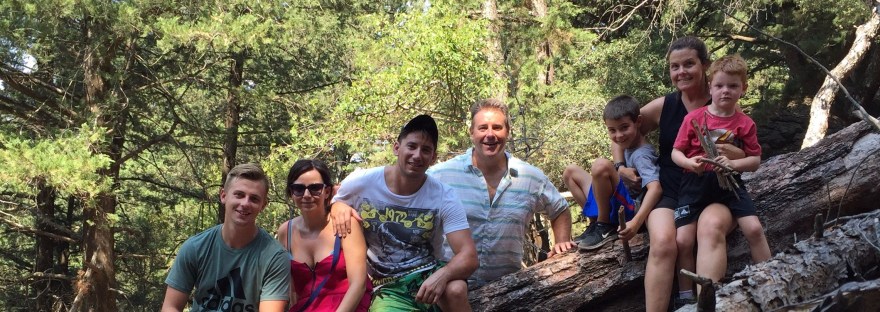
From there we drove to Profitis Ilias (Prophet Elijah), a mountain with sea views about 26 km from Rhodes town. There is a beautiful chalet at the top surrounded by forest that is home to the rare “dama dama” deer. The chalet building was constructed in 1929 by Italian colonists, commandeered by the Nazis during WWII and used as a hospital for German soldiers, and now it’s a hotel. There’s also a villa onsite that was the summer residence of the Italian Governor of Rhodes from 1936-40.  This was intended as a retirement home for Benito Mussolini; the photo of us on this page is just below the villa. Obviously Mussolini never retired here. We had a lovely lunch in the hotel (which had a huge bookshelf full of kids’ toys, bless them) and headed to Lindos.

Lindos was founded by the Dorians in the 10th century B.C.  It’s a pretty little village with a large acropolis at the top.  We arrived at 6:45 and had an hour to see it – we literally jogged through the alleys and up the hill to get in before closing time and sunset.  It was hot and very humid; we were grateful for breezes at the top.  There was considerable ancient wealth here – the archaeological museum has some wonderful pieces found in and around the Lindos acropolis. The Dorians built a temple to Athena Lindia in the 4th century on top of another destroyed temple, a Hellenistic Wall surrounds the Acropolis, and there is a Roman temple dedicated to Emperor Diocletian. All of these are protected by a castle built by the Knights of St. John in the 1300s.  Outside the walls are the remains of an ancient theater.

Side note: we logged some 16,000 steps (6.5 miles) on this exploration day — and this included a few hours of driving.

On our last night in Rhodes, we visited a very traditional taverna in Psinthos — most of the dishes (goat in tomato sauce with chickpeas, lamb with lemon, oven cooked pork) had been cooking for hours.  We decided to go early, arriving around 8 pm which turned out to be a smart move as by 845 the restaurant was completely full.  We ended the evening as we have most of the summer — kids asleep at horrible angles in the backseat, carrying them into bed at midnight (or later).


Greek life, Travels

Rhodes, part 1

Most of Europe takes holiday in August – and the beaches and islands of Greece are a popular destination. Demetri’s been interested in Rhodes (Rodos in Greek) for many reasons, so our August holiday is a week here.  We rented a lovely house in the village of Koskinou with a swimming pool and room for 8 of us – Papou, Theodoris and Mina and us five.

Rhodes is the capital of and largest island in the Dodecanse islands.  It’s less than 10 km from Turkey, in fact on clear days we could see the Turkish coast from our kitchen. The first settlers look to have arrived in 500 BC; Rhodes became a strong power in the years to follow.  The Colossus of Rhodes, one of the seven wonders of the ancient world, was constructed in the harbor of Rhodes town.

The island was under Roman rule for 300 years starting in 70 A.D., and then occupied by Venetians and Turks. It was controlled by Italy until 1947 when it was transferred to Greece.  There’s a great deal of Italian influence here – architecture, food, leather, residents, gelato …. we had some lovely dinners inside the old city in the taverna gardens.

The town of Rhodes has an amazing walled old city fortified by the Knights of Saint John in 1309. Their initial role was to care for wounded and ailing crusaders, and they built a large hospital.  The Knights represented all of the major European catholic countries – a total of 8 ‘houses’ — and they restored and built about 30 castles on the island.  The old city was the main fortress; during foreign attacks each group of Knights was assigned to defend certain sections.  The large moat is now a public park.  Rhodes was finally captured by the Turks in 1522, but because the Knights had fought so valiantly, they were given safe passage out (significant —  this is not the way the Ottoman Empire rolled).  Thousands of Rhodians departed with them; many settled in Crete which is southeast of Rhodes.  The Knights themselves found a new home in Malta.

The Palace of Grand Masters, built in the 14th century by the Knights, has 150+ rooms. 24 are open to the public now & they’re filled with mosaics, multicolored marble, frescoes, beautiful tile and antique furniture from the 16th century (Peter called one collection of tall seats the “knight cubbies”).  Because the Italians occupied and controlled Rhodes until after WWII, they were the ones who restored the castle in the early 20th century.  The Palace served as holiday residence for King Victor Emmanuel III and Benito Mussolini.  There’s a grand plaque in the front hall honoring both men … and Fascism. It has a beautiful inner courtyard full of statues from the Greek and Roman periods.  Today, the Palace and the fabulous archaeological museum around the corner belong to the Greek state.

Walking through this old city is amazingly cool.  The streets are cobblestone, the sidewalks are full of mosaics and there are fountains and springs for a quick drink or a splash on the face.

Greek life, Travels

Peloponnesian road trip

The purchase of a car necessitated a road trip.  We returned the car (story in a future post) but we went on the road trip anyway in a rental.  The Peloponnese are the ‘fingers’ to the west of the mainland.  It is a beautiful area.  We spent time on the far west coast (Pilos, Stupa, Kalamata, Costa Navarino) in 2014. In 2016, we spent a long weekend in Loutraki, near the Corinth canal.  The Peloponnese region was quite significant in Greek history — the Peloponnesian Wars (431-404 BC) essentially took power away from the Athens city-state, and established Sparta, the leading power of the Peloponnesian League as the dominant force. These wars were the abrupt end of the golden age of ancient Greece.

This time, our destination was a town called Korfos, a village on the sea.  Papou and Sandy came too and we had a little townhouse with a lovely garden that was just up from the water.  We crossed the Corinth canal, stopping to watch some boats travel through, arrived about 5 pm, swam at the pool, had some wine and snacks, and went to dinner later at a little Taverna on the water.

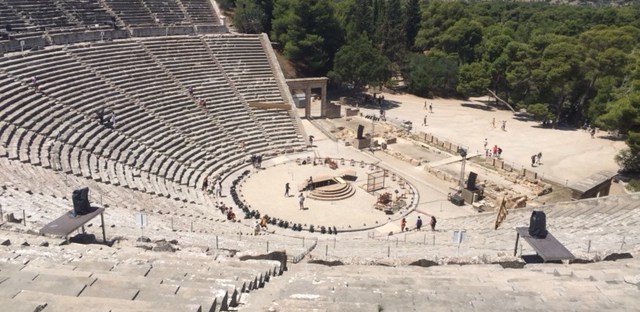
The next morning, the four of us drove to the ancient Theater of Epidavros. Built in the 6th Century BC, it is one of the most perfectly preserved sites from its time.  The acoustics are terrific — we could hear a coin drop on the stage while we were at the very top.  In the same site was a temple dedicated to Apollo Meleatas, a god with healing properties, and the Asclepieion, the seat of antiquity’s physician god — people started worshipping him in the 6th century. There were also dormitories, a stadium, and ancient market.

We left Epidavros and drove to Porto Cheli, a little harbor town. From there we took a water taxi to the island of Spetsis, one the Saronic islands.  Spetsis is adorable. No cars are allowed, so you get around by motor scooter, taxi or horse carriage. We stopped for a late lunch near the harbor and wandered down the streets lined with lovely boutiques and shops.  Then we took a quick swim, diving into the ocean from a pier.  It was terribly hot so our tempers and bodies cooled down nicely with a little swimming.  Then we took a water taxi back to Porto Cheli and the car, and drove along the coast back to Korfos.  Papou and Sandy spent the day closer to home at Metamorfosi and other towns.  Demetri, Sandy and I have all just finished Blue Skies and Black Olivesa really funny father/son account of building a house in Greece.  Demetri found the house on our way back, and though Papou felt we should knock on the door and tell him how much we enjoyed the read, we didn’t.  We stopped for ice cream in Galatsas and headed home.

Saturday we woke late, swam in the pool for a little while, and drove to Drepano Beach. Saw many goats and goat herders along the way.  Papou’s first cousin Elena — a Greek who has lived in Florence since birth — spends summers in Drepano.  Elena is funny, charismatic, and full of life.  The perfect mix of what an Italian Greek should be.  The water in Drepano is the best I’ve ever seen. The beach is rocky, but the water in the ocean has soft sand for miles.  The water was so clear it looked like a swimming pool with a sand bottom.  We swam for a bit, then went back to Elena’s apartment for a linguine with mushrooms and truffles pasta lunch.  It was her husband’s birthday (Massimo).  There was champagne, fresh cheese from Florence and Greece, and the most beautiful fruit tart birthday cake with grapes, figs, apples and plums.  Elena’s brother (Renato) and his wife (Ornella) also joined us.  I didn’t know until yesterday that Papou speaks Italian, so he was the hardest working guy at the party, translating from Greek to English to Italian to English and back to Greek.

Next stop, Rodos.

Greek life, Travels

Syros


Demetri attended a language class on Syros, the capital of the Cyclades this last week.  The class was great — he was the only US citizen in the group — and he was out each day around 2 so he could do his homework and enjoy some of the island.

There is a bit of money on Syros and it’s well populated — 22,000 or thereabouts, with most of the folks living in the city of Ermoupolis, named for Hermes, the wing-footed god of trade and business.  It was the busiest and most important port in Greece for many years, even more so than Piraeus.  There is also a great deal of culture in the city, including the pretty Apollo Opera House, modeled after La Scala in Milan. Demetri and his dad saw Madam Butterfly one night while we were here.

The kids, Sandy, Peter and I spent most of the days at the swimming pool at The Sunrise Beach Suites in the beach town of Azolimnos.  In the evenings we enjoyed Ermopoulis and its pedestrian walkway streets, the Plateia Maniouli square, and the churches of Agios Nikolas (the patron Saint of sailors) and the hilltop Church of Resurrection.

Syros is different looking than other Cycladic islands.  It has a lot of Venetian influence in the architecture, and the city of Ermoupoulis is almost all neo-classical architecture instead of the traditional Cycladic look (though there are lots of that for sure).  Syros is the one island that was never occupied by the Turks — it was under Vatican protection for years and there is a strong catholic culture on the island.  The Catholic Church (St. George) on the opposite hill of the orthodox Church of the Resurrection, has been destroyed and rebuilt FIVE TIMES on the same spot.  Lighting hits the bell tower rather frequently.

Papou, the kids and I spent a morning in the medieval town of Ano Syros which is home to St. George, another Agios Nikolas (St. Nicholas) and winding narrow streets and a cafe with a spectacular view.

Our fabulous week came to an end with the arrival of the Naxos Blue Star Ferry, which took us back to Piraeus yesterday.  Two weeks of island living was great and we’re already planning our next trip!  Rhodes is in the plan for August, maybe Kos and Patmos as well.  More on that later.

Greek life, Travels

Milos

I’m completely in love with this island. It has many interesting beaches, adorable towns, cool topography and a nice little port. Like Santorini, it’s on a volcano, so the soil is rich and the rocks are a combination of frozen lava, volcano ash and red Sulphur. Our first day was very windy so we drove to Paleohori beach on the south side of the island where the wind wasn’t as bad.  There we found a great taverna on the beach with beach chairs and umbrellas.  Sirocco, the restaurant, had a volcanic sand oven that cooked much of the taverna’s food.  The smell of Sulphur was strong in certain places, there were little hot springs under the sand (evidenced by a constant stream of little tiny bubbles under the water) and in certain places, if you stood too long, your feet would start burning.   Michael was promoted to Deputy Safety Patrol Manager after a daring sea rescue when he thought Peter had drifted too far out on the inflatable turtle. I happened to agree with Michael and swam out to get Peter, when all of the sudden the turtle’s flipper was ripped from my hands by a tiny blue-masked snorkeler with little tan feet.  Because I was behind the turtle pushing it to shore, I never even saw Michael coming.  I just saw his tan little feet paddling back with the turtle’s other flippers firmly in his grasp.  Peter, as usual, enjoyed the ride.

We took a nifty day-long catamaran trip around the island, as the most beautiful places to see are best by boat (and difficult by car).  I was sure the kids would go overboard, but the captain assured me that in 22 years of sailing, it’s never happened.  We saw the ancient town of Klima, the rocks, caves and beach of Sarakiniko; the largest catacombs outside of Rome; 8 dolphins swimming around and under our boat, the famed pirate-haunted rocks and caves of Kleftiko beach, and a church on a mountain that marks where Aprhodite o Milos (Venus de Milo) was discovered.  We anchored 4-5 times and jumped in to swim in water so clear you could see your feet dangling above the sea floor that was 20 feet down.  Demetri swam through caves and tunnels.

Friday, we took a day trip by ferry to the island of Kimolos, a 25 minute ferry ride from Pollonia beach where we stayed, and spent the afternoon on the white sand Prassa (“chalk”) beach, making sandcastles and climbing into rock forts.

We also spent lots of time in our beautiful house in Pollonia, where we could walk down the rocks and be in the water.  One day the water was calm enough that we all tried the Stand Up Paddle board – even Peter – and we spent the rest of the afternoon and evening taking turns on it.  Michael was a natural from the first moment he stepped on.  I had a good teacher (Demetri) who told me how much I would fall the first time out and how to get off and on – and how to jump off when I did fall without having the paddle board equivalent of a skiing yard sale (which I did only once).

We toured the ancient theater and stadium which sit below the Venus de Milo discovery site and just above the ancient village of Klima.  Michael and Demetri also went into the the catacombs – 200 graves and 6000 buried (my grandfather would say “ahhh, bunk beds.”)

Each evening we enjoyed the cute strip of tsarotavernas (fish taverns) and psistariás (grill taverns) and found a favorite spot, Molos, with servers we befriended who brought us a drink of mastica and the kids a bowl of bubble gum ice cream after dinner. One kind server made sure to have us visit their sister restaurant (right next door) so we could eat the fresh red snapper that was being pulled off the boats.

Milos is one of the ‘undiscovered’ islands – not very built up, and no cruise ships yet.  An article in Conde Nast Traveler earlier this spring spotlighted Milos and there were lots of Americans in the hotel (maybe the only traditional hotel in Pollonia) we stayed on our last night. Milos is beautiful.  I can’t wait to come back.