Travels

Berlin 2

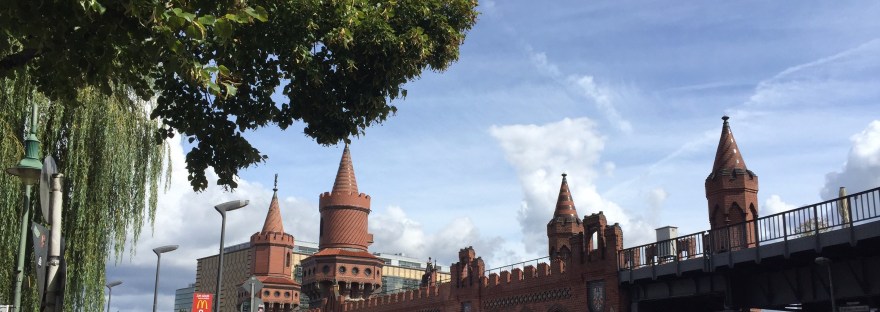
There was a great “Where” magazine at the hotel (we have them in the states, yes?) that listed a whole bunch of things happening in Berlin during the month of September, so we decided to do a few.  We boarded the U-Bahn (subway) to an open-air art show taking place under a pretty, old Berlin bridge.  We watched a rock band, some acoustic singers, a New Orleans style jazz band (the sax player was from Rhode Island) and looked at paintings and sculpture and this cool duct tape art on the street.  We saw more of the Berlin Wall and walked along the river.  Next, our plan was to visit the Berlin Circus Festival held at the Nazi-era airport, now a park.  It started raining, so we decided to have lunch and wait it out in a middle eastern restaurant.  When the rain let up, we got on the S-Bahn (elevated train) for Tempelhof Feld.  We walked and walked, then boarded a bus, got off where we thought we should. No visible circus, but there was minigolf!  So we did that instead.  The clouds got darker and darker; we finished our game and walked toward the bus stop, watched an inning of the Berlin Braves (Demetri was recruited to play, but couldn’t because he wasn’t a city resident) and got back on the bus in a downpour.  Riding the city bus is a trick we learned from Rick Steves in ’08 when we visited Paris. We transferred to another bus and walked back to our hotel along the Spree (river).  After 10 weeks of being in Europe, we still forget that cities essentially close on Sundays.  We squeezed into a Thai restaurant just as they were closing.

I had many years of German in high school and college, and I should know more than I do.  I used it a bit here but had to laugh because when I would ask or order something in German, everyone answered me in English.

After breakfast on Day Three, we took the S-Bahn to Nikolaiviertel, one of the city’s oldest quarters.  It had cobblestone, curvy streets, big trees and lovely old buildings.  We walked past the famous tv tower in Alexanderplatz, and had a coffee and played some chess in a café.  Then we boarded the #100 city bus to sightsee above ground. Peter was apoplectic that it was a double decker, as the bus approached he screamed as if he won the lottery. The 100 took us along a route where we saw the highlights of Berlin – the Reichstag Building, the current federal building where the Chancellor’s office is, the victory column, Museum island, Tiergarten Park, and the Kaiser Wilhelm Church, which is still damaged and a reminder of the war.  Our last stop was the Zoo Garden station. We walked, window shopped, ate and played in a little park called Los Angeles Platz.  We decided to take the S-Bahn back to our ‘hood to see the city from a different above-ground vantage point.  We exited at the Markthöische station, an market building now filled with restaurants, bars and cafes.  We stopped for dinner in a restaurant that’s been there since 1840. They served schnitzel with chanterelles (and many other things), slices of meatloaf between pretzel halves, spetzelkäse and cold, delicious Warsteiner.  Our last half day we spent swimming in the hotel pool, drawing and playing.  We ducked into a beautiful chocolate shop on our way to the airport train for a gift for Papou, who will surely be waiting at the Athens airport for us.

3.75 days wasn’t enough for Berlin, but it was a great introduction to the city and we have a list of things to do and see when we come back. It’s a fabulous city. Auf wiedersehen Berlin.  Wir lieben Sie.
 

Travels

Wir lieben Berlin

We had planned to stop in Dresden on the way to Berlin.  Considered a strategic target in World War II, the allies bombed the heck out of it to the point of devastation.  The rain changed our plans – it was coming down in buckets and we had only one umbrella, no adult rain gear and too many backpacks – so we headed straight to Berlin. The central terminal is sleek and shiny and almost like a mall. The city symbol is a bear, and like Denver’s cows, there were bear statues in various colors and costumes all over the city.  Our hotel was in the former east Berlin, near the Gendarmarie market and not far from Checkpoint Charlie, which we visited the next morning.

Michael looked around when we got to our hotel and said, ‘wow, this is, like, a brand new city.’ And the former east Berlin is that for sure, and especially compared to Prague, Vienna and Budapest. Parts of the Berlin Wall exist around town and are made to be open-air museums and exhibitions.  There were three gates between east and west – A, B and C.  They were given NATO agreed upon letters, hence C for Charlie.  There’s a funny fake ‘gate’ with actors in military uniforms and sunglasses with whom you can take your picture or photograph them stamping your passport.  Down the block we stopped into a Trabant museum, which was an interesting little display of the various cars (sorry, I mean one car) that was available in the countries within the iron curtain.  You could have your choice of three colors, but only one car.  There was a great film running about its design and manufacturing – Trabant actually designed the hatchback, but Moscow didn’t want the ‘new’ stuff coming from Germany, only from Moscow.  So Trabant never released the hatchback, but somehow VW got its hands on the design and they were the ones to make hatchback history.

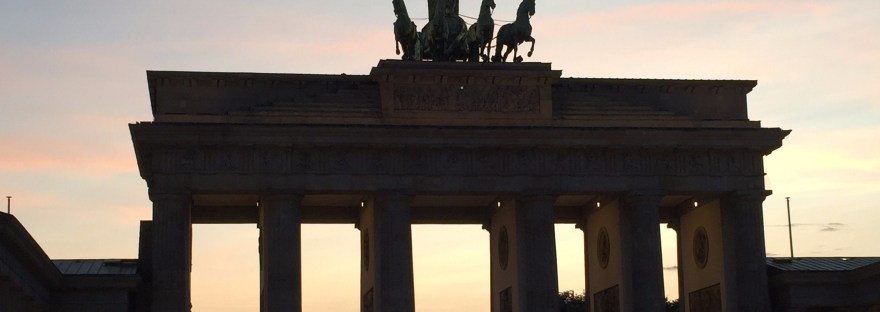
We left the Trabi museum and walked to the Topographie des Terror, a museum with indoor and outoor exhibitions on the rise of the Nazi regime.  The museum sits on the grounds where the SS, Secret Police and the Reichstag Security offices were located during World War II – they were bombed to nothing by the allies in 1945. Demetri and I took turns in the exhibits while the kids drove their matchbox-sized Trabis around the sidewalks and bannisters. From there we walked to Potsdamer Platz, which was sort of no-man’s land when the city was divided up, because the Berlin Wall bisected it.  Prior to that it was a busy  city square.  We had some food and continued walking to an apartment complex built on top of Hitler’s bunker where he, Eva Braun and Joseph Goebbels were from January ’45 until their suicides that April.  The bunker was excavated, inventoried and essentially destroyed in the late 80s, and the few remaining corridors were resealed.   Not far from the bunker site is the Memorial to the Murdered Jews of Europe, Berlin’s Holocaust memorial. Outside, the memorial is 19,000 square meters with 2711 concrete blocks.  The inside memorial contains diaries, letters and last notes written during the Holocaust, a room of names of all missing and murdered Jews in Europe and video interviews with survivors that can be watched in 10 languages.  It’s devastating and emotional and very well done.  From there we walked past the US Embassy (just coincidence), along the edge of Tiergarten Park (the size of Central Park in NYC) boogied to Uptown Funk blasting from the pole vaulting competition (USA came in first, Germany second), and crossed through the Brandenburg Gate onto Unter des Linden street, which looked like a combination of national mall and NYC’s Fifth Avenue. It runs from the Palace to Brandenburg Gate.  We stopped for a coffee (Demetri), dessert (kids) and limoncello (me) on the way back to our hotel.  We were totally underdressed for fall-like Berlin in our lightweight summer clothes.


Travels

Prague

Prague has something like ten or eleven nicknames. I don’t know which is most common or the oldest, but the one I can wrap my head around best is ‘city of one hundred spires.’ (There was a bad translation on one of our tours and it called Prague the city of one hundred spices).  We didn’t count them, but just looking out from the top of Prague castle, you see why.

Our hotel had a peacock. Seriously.  We arrived late-ish on our first night, and decided the wise thing to do would be to sit in the patio and eat there.  I looked up and saw it sitting on top of the patio columns.  There was also a white peahen (only males are called peacocks, didn’t know that) that we saw on our last day.  Prague castle had a few of them wandering around too.

My dad’s grandparents were from Czechoslovakia, and his grandmother from Prague.  I was excited to be here.

Our first order of business was laundry.   We packed very light – basically 3 days of clothing, so after day 9 and washing stuff in bathroom sinks we were ready for truly clean clothes.  There was a wet/dry cleaner just a block away – perfect. We could pick up our laundry after 5 pm and with that, we headed to Cacao Café to plan our day.

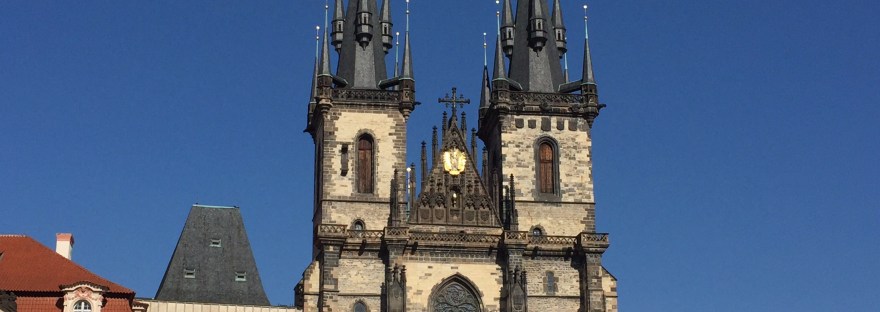
From there, we walked through Powder Gate to Old Town Square, the home of one gothic church and one baroque church, the famous astronomical clock (sadly under construction so it was just chiming on the hour and not doing all the other stuff), the art museum, a statue to religious reformer Jan Hus (the Hussite Wars were against the corruption of the papacy and the Catholic Church) and tons of street performers.  The boys had 2 favorites: a man-baby with a white painted face and a squeaker in his mouth, and a group of teenagers singing Lumineers songs. We took a little train ride through old town, the Jewish quarter and into Mala Strana (“lesser town” – the other side of the river).  After that, we  wandered through the streets and alleys and cool passageways in Prague. Ate some street food – the most delicious cabbage/potato combination and a ‘pork knee’ – don’t let it freak you out, it was mostly ham.   We played at Franciscan Gardens, a former Carmelite monastery that is now cared for by the Franciscans. It had a really nice playground and beautiful flower gardens surrounded by yew hedges.  We stopped for new socks, picked up our laundry, changed clothes and strolled through Prague along the river and looked for dinner.  We ended up at the original Pilsner Urquell brewery, per the signage.  After looking at the menu and seeing all the other locations, we realized we might be at the Czech version of Applebee’s.

We spent Day 2 in Mala Strana – across the river.  We walked through Republic Square and down and across the pedestrian only Charles Bridge, full of arches and statues and bands and artists.  The best time to go is dawn for the sunrise, but since we are physically unable to get to bed before midnight any night this summer, sunrise is not happening, except through one eye from our beds.

Mala Strana is home to the John Lennon Wall – city-sanctioned graffiti that started after Lennon’s death as a form of passive resistance against the communist outlawing of western music.  The wall is colorful and always changing and anyone is welcome to bring a sharpie and leave a mark.  Coincidentally, this wall is owned by the Knights of St. John (see our Rhodes posts), as it is part of their embassy building.  From there we walked into Kampa Park, past the David Cerny bronze faceless baby statues and stopped so the boys could climb, play, wrestle and sword (stick) fight.  We had a beer in the park, then crossed another bridge and stopped in a beer garden for a snack and another beer, and then walked to Wenceslas Square.  Named for King Wenceslas, the patron saint of Bohemia, this ‘square’ is more grand boulevard than a plaza.  It’s surrounded by office buildings, cafés and retails, and one end has the national art museum.  The square is the site of many protests – the Nazis used it for mass demonstrations, it’s the site where the young student lit himself on fire in 1969 to protest the Soviet invasion, and where many demonstrations were held in the 1989 Velvet Revolution, the violence-free transition of power from communism to parliamentary representation.

Day 3 started at the American Embassy, also in Mala Strana, to get some papers notarized. We met a California woman who had her purse swiped at mass the day before, and for someone who had all her money and identification stolen, she was incredibly upbeat.  She was glad she didn’t bring any credit cards with her and her breakfast and dinners were covered with her tour, so all in all, she said, she was really fine.  The people on the tour were her friends, so they could spot her cash if needed.  Demetri told her about Venmo and how it would be easy to pay them back, she was grateful and she jogged off to meet up with her tour group.  We had a coffee, met some folks from Rochester, and hopped on the city tram.  Our destination was DHL to ship the notarized docs to Denver, but above-ground public transport is a great way to sightsee when little legs are tired or whiny.  After DHL we got back on the tram and headed into Franciscan Gardens again.  The boys met a little 5 year old named Mavek, who looked like our two boys merged together (dark hair and freckles) and whose English was as good as ours. They played together for an hour and a half – rotating between characters from Star Wars, Moana and Power Rangers.  From there we took the train to Prague Castle, built around 850.  It’s a complex of sorts – palaces and religious buildings  that are gothic and baroque and Romanesque (I am not good at this part and knowing what’s what), and it includes the magnificent St. Vitus Cathedral.  It was closed, so we couldn’t see inside.  Since the Velvet Revolution, it’s had tons of repairs and reconstruction.  It started raining, but that didn’t stop Demetri from initiating a game of hide and seek tag among the Austrian pines on the palace grounds. We left tired and soggy, but we sure had fun.  We ate in a Czech beer hall and hopped into a taxi, looking back at the Prague Castle, which is lit up at night thanks to the Rolling Stones. They’ve footed the bill since the 90s.  The rain continued into Friday and we said goodbye to Prague from the main train station, passing through cute little country villages on our way north.

Travels

Brno

We boarded a train for the Czech Republic and stopped an hour and a half in at the adorable city of Brno.  Located in the Czech state of Moravia, it’s the second largest city in the country. We only had a few hours, so we had a coffee and went straight to Freedom Square and wandered through the markets, bought the most delicious raspberries I have ever had, and walked up to the Cathedral of Sts. Peter and Paul, first built in the 12th century for St. Peter; St. Paul was added in the 1600s.  It’s the highest structure in the city.  There were laminated pages in 10 languages you could borrow to read the history of the cathedral.

Brno’s medieval castle is now home to the city museum and St. James Church has a crypt and ossuary thanks to medieval plague and cholera epidemics and later the Thirty Years’ War and various Swedish sieges (seriously, read the link).  Sadly, the ossuary is closed on Mondays, which is too bad because it would have given the kids discussion topics (and bad dreams?) for years to come.  We all shared some sorbet – currant and grapefruit/sage – and walked back to the train station to head to Prague.  It’s a city we’ll come back to for sure.

And I wonder what sort of Thanksgiving cocktail I can dream up with grapefruit and sage …


Travels

Vienna 2

Peter turned 5 August 25.  He wasn’t so sure about this whole travelling-on-his-birthday-thing, where would the cake be (hello, we’re in Vienna), what about presents, what about a party? We promised it would be a great day that he would love.  He chose to swim at the hotel and then go to the Vienna Zoo, which is ranked top in Europe. Lucky for Peter’s parents, the zoo is on the grounds of the Schonbrunn, which was the Habsburg summer palace. Mozart gave his first concert here at 6 years old.  It was built in the 1600s and modelled after Versailles; the zoo was the menagerie.  It was a great zoo – probably the size of Denver’s, but they packed way more animals in there (not yucky though).  Their big attraction is the 1 year old giant panda twins.  They were napping outside, so we got to see them even if they were just laying there. The penguins were, as always, a delight, and every tourist in front of the ring-tailed lemurs either said “King Julien!” or sang “I like to move it move it.”  After 4 hours at the zoo, we exited by spending 2 more hours in the gardens, fountains and tree mazes of the Schonbrunn grounds. Maria Theresa had 16 children – Marie Antoinette (nee Maria Antonia) was one of them – and we talked about how much fun 16 siblings could have in this backyard.  That evening we had a great dinner near our hotel at the apex of the Burgring and the Opernring – this restaurant served veal or pork or chicken schnitzel and it had free foosball.  Our server, Paula from Venice, brought Peter a huge waffle with ice cream and five candles.  Peter left with a full belly, a kiss from a pretty Italian girl and a new little tiger lovey named Tyrone or Ranger or Cutie Fluffy. Michael missed the singing and the candles because he was accidentally trapped in the bathroom, but he screamed so loud (safety training from Daddy) that Demetri heard him.

We spent time at the Belvedere, another palace turned museum.  The Belvedere houses Gustav Klimt’s “Kiss” and other Klimt works, on top of many other beautiful paintings and sculptures.  The kids were totally fried and toured out, so we also boarded a bus to see other parts of the city we realized we might not walk to – definitely a good choice. Thanks to Vienna Unwrapped, we found a terrific ‘hot dog’ stand near the Albertina and twice enjoyed dinner and beer there sitting on a fountain ledge. One day, Demetri took the kids swimming at the hotel and did some yoga with them, then he went to the Naschmarkt and a cafes. While they were swimming, I toured churches and the national library and the kids and I went to the Natural History Museum – yet another palace turned museum so pretty it wouldn’t matter if the building was empty – and saw dioramas of dogs, cats, sharks, alligators, birds, dinosaurs.  Our last evening was spent at zum Schwartzen Kameel, a café and restaurant that’s existed since 1618.  The food was terrific and the restaurant and bar were gorgeous. Campari made 999 bottles of their liqueur for the Black Camel (special label) and some of very rare ones are in storage. Sadly we had to settle for Aperol spritzes, because only the bartender can make Campari drinks, and they don’t work Sundays.

In total we spent 5 nights in beautiful Vienna & could have spent many more. There is a ton to do, it’s very kid friendly with many parks and great public transportation that can serve as a sightseeing tool if kids are tired, the food is lovely and the buildings are gorgeous. Everyone speaks English, but I had a chance to practice my German and brush up on my Habsburgs and Holy Roman Empire a bit here. It reminded me how much I loved Mr. Reynolds’ European History class.