
Greek life, Travels

Mycenae

My friend Roberta – we met in junior high soccer – came for a visit last week.  All by herself, which disappointed Michael and Peter since she and her husband have three fabulous daughters who both my boys adore.  Since Roberta had been to Athens before, we decided on a few ‘second visit’ things to do, like the Elias Lalaounis jewelry museum (a fave), and the Benizelos (Μπενιζελωσ — not to be confused with Venizelos) mansion, a quick trip to Nafplio, Epidaurus and Mycenae.

The Benizelos mansion is really neat.  Nestled in between shops and tavernas on Adrianou Street, it sits just in front of the Roman Agora.  Built in the 16th century, it’s the oldest surviving house in Athens.  It’s a typical urban nobility house from the Ottoman period. The upper floor is sort of a labyrinth made of timber.  The home’s most famous inhabitant was Revoula Benizelos, later martyred as St. Philothei, a woman who after being widowed very young, started a monastery that gave shelter, food and care to the poor and also provided refuge to slaves and Muslim women who had converted to Christianity. The Turks killed her for that in the late 1500s; she is one of the only saints to have been martyred during Ottoman rule.

Our next stop was Mycenae, home to the ancient civilization renowned for its technical advancements as well as artistic wealth — which played an important role in the development of classical Greece and its culture.  The ruins of this fortified citadel date back to 1600 BC and the most impressive element of Mycenae are its tombs, in which archaeologists found jewelry, weapons and tools, plus things that came from other parts of the world: ivory, tin, even lapis. The Myceneans were among the first to use bronze and it was here that the first pieces of the Greek language, preserved on Linear B tables, were discovered.  Mythology says Mycenae was founded by Perseus who employed the Cyclopes to build the city walls from rocks that no human could lift.  It’s also said to be the inspiration for Homer’s epic poem. Its most famous king was Agamemnon, who helped his brother Menelaus rescue Menelaus’ wife Helen, during the Trojan War (yes, that Helen).  Agamemnon and his wife Clytemnestra had two children, Orestes and Electra.  After Clytemnestra and her lover murdered Agamemnon in the bathtub, Electra and Orestes spent years working to avenge their father’s death.  I think I have this right.

Now, I knew this story from high school English class and the great play by Euripides.  In the 19th century, archaeologists found the bronze burial mask of King Agamemnon … and they excavated the bathtub he died in.  Turns out Agamemnon may not have been a fictional character at all.  You can find this mask in the National Archaeological Museum in Athens.
 

Travels

Mosques, fortresses and cathedrals

For the last 5 nights of our trip, we based ourselves in Madrid, wandering through the grand El Retiro Park, eating tapas and exploring the old part of the city. On our way from Seville, we hopped off the train in Cordoba in the pouring rain. We made our way to the Mezquita, Cordoba’s huge mosque-cathedral, which was built as a Visigoth Christian temple in the 6th century. With the arrival of the Moors in the 8th century, it was divided and used by both communities. By this time, Cordoba was the western Islamic capital. UNESCO calls the Mezquita “a testimony to the ancient alliance of art and faith.” Beautiful words that summarize it perfectly. The roof of this dazzling, enormous building is supported by 800+ columns, many of which were recycled from Roman and Visigoth buildings. In the 1500s, the mosque was destroyed to build a cathedral. We splurged on audio guides for the Mezquita mostly because they had a special kids’ tour. I listened to one kid segment about the mihrab and it was so well done. The adult version assumed the listener knows the Muslim faith — and I really don’t. I think the kids listened to almost all of the chapters before turning their audio guides into light sabers and walkie talkies.

Our next half-day trip was a 27 minute train ride to Segovia. In Roman times, it was a military base in need of water, so Trajan’s engineers pulled water 9 miles into town from a nearby river. This massive 2-level structure (2500 feet long; 118 arches) is dry-laid, which was as impressive then as now. Spaniards claim it could still work today. We walked from the aqueduct to the Plaza Mayor, the town center, which used to be the local bullfighting venue. Today it has a big market with the usual produce and the biggest olive and pickled vegetable stand I’ve ever seen.

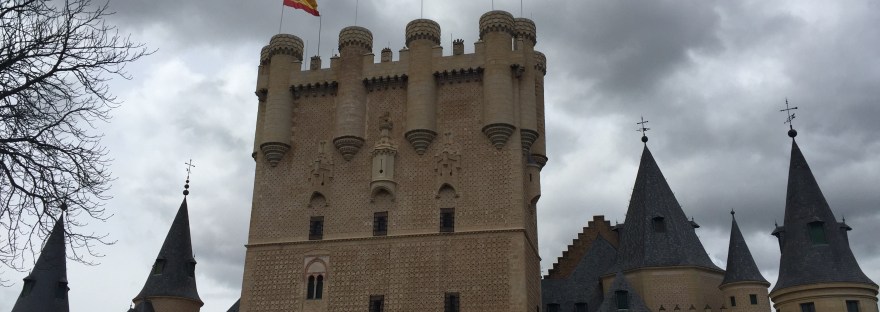
From there we walked into the Segovia cathedral which stands high up from the plaza. It’s a beautiful building in the “flamboyant gothic” style and is Spain’s last major gothic building. The Alcázar (fortress) stands at the far end of town and looks like a fairy tale. In fact, it’s rumored to be the inspiration for the Disney castle.

And our final trip was 30 miles south of Madrid to Toledo, a medieval city that’s still inhabited, busy, communal – even though nothing modern has been built. In the 80s, the whole town was declared a UNESCO site. For several hundred years, Toledo was an important Roman transportation hub; the Visigoths took over when Rome fell, and then the Moors came in the 700s, and ruled until the Christians took over and made Toledo Spain’s political and religious capital until Charles V (or maybe Philip II?) moved the capital to Madrid in the 1600s. Spain was neutral during World War II, so didn’t get bombed out like the rest of Europe. Churches, castles, fortresses by and large are terrifically preserved.

Toledo has a gorgeous cathedral (the 4th largest in Europe), a very pretty, old synagogue, a beautiful monastery and a great Museum with beautiful grounds dedicated to El Greco.

It’s fascinating to learn how tolerant the Moors were of the people they ruled – and we found this in all three of these cities. Jews, Muslims and Christians lived together harmoniously in one community – eating the same food, dressing the same – the only difference was their religious traditions. That is until 1492 when Spain unified as a Catholic country and demanded the Moors and Jews convert or leave.

We have learned enough Greek to recognize it and know what people are saying. We saw a few Greek tourists in Spain – Peter was delighted with himself when he’d greet them with a “Γεια σας!” The Greeks were pleasantly surprised to get a nice, unexpected hello. And a Spanish woman today called him Guapo. He knew what it meant as the boys have been watching “Ferdinand” on every train ride.

Michael climbs everything in site. He did 100 laps around a the roots of a huge 300-year old magnolia and today scaled a wall and slid down a no parking sign pole. He’s also styling his hair. How did he get to 8 so fast?

Two weeks gone in the blink of an eye. Kinda like the last 10 months.

Travels

Seville

After the Americas were discovered, Seville was the economic center of the Spanish empire, because its protected up-river port had the monopoly on trade. These new riches helped Spanish culture flourish in the 17th century.

Most of the major sites are within walking distance of the city center. The enormous cathedral, originally a mosque built by the Almohads (Moors from Morocco) in the 12th century, is best viewed from a rooftop somewhere — while you get a sense of the size as you walk past it, seeing its top outline takes your breath away. It’s the third largest cathedral by footprint (1- St.Peter’s in Rome; 2-St. Paul’s in London) in Europe and the largest by volume. Its bell tower was originally a minaret; in the 1400s the Muslim ornaments were changed to Christian symbols.

We toured the Real Alcazar, the royal Palace, commissioned by Pedro I to be built within the palaces that were originally constructed by the Almohads. Pedro’s palace was completed in two years; later monarchs e.g., Ferdinand and Isabella, Charles V, Philip II, added their own grand touches. It’s still used today when the Spanish royal family visits Seville. Water — fountains, ponds — is everywhere, symbolizing the greatest Muslim gift you can give. The bright tile work, carved ceilings and grand marble wall carvings are astounding. You don’t see this moorish influence anywhere else in Europe and it’s gorgeous. The grounds are also spectacular; some 5 acres of plants including a labyrinth, and several walking paths. We ran across two new packs of ducklings on our walk.

Seville’s main green area is the Parque Maria Luisa, formed by former palace grounds. We hung here for a lot of Sunday – along with thousands of joggers, bikers, scooters and a bunch of people who just finished some sort of race. We also caught some terrific flamenco in Plaza de Espana, a pretty tile-laden square in front of the old palace. Sunday night we went to a Corrida de Toros (a bullfight) — no doubt the most controversial tradition in Spain, but one very ingrained in Sevilla culture.

People go to Sevilla for the city vibe. Bizet’s Carmen was from here. Sevillans know how to have fun, as evidenced by the gazillions of girls’ weekends and bachelorette parties touring all the sites. Tapas are the only food game: eat one or two, have a beer and move on to the next spot. It’s simple food designed for quick stops. Lots of beef and pork, fried fish galore, and the tastiest spinach and garbanzo dish ever. We left Seville in the rain in search of the next mosque-cathedral just an hour north.

Travels

Valencia

Spain’s third largest city was the favorite of our Spring Break trip. And not because it’s got Europe’s oldest market filled with produce, nuts, meats, cheeses, wines, beers, dried fruits and chocolates. Not because it’s the birthplace of paella, which you can get all over town (and the Valenciana is definitely the best of all paella offerings.). Not because of the fantastic orange named for this city. Not because the cathedral claims to have the holy grail. Not because it has a beautiful old city just a mile away from the slick, futuristic City of Arts and Sciences, a five-area complex including an opera house, an IMAX theatre, a garden area, a science museum, and an open-air oceanographic park.

Nope. None of that. The most spectacular thing in Valencia is its Jardin del Turia, a nine kilometer park where the Turia River used to be. After a huge flood in the 1950s, city planners re-routed the Turia and turned the old riverbed into this glorious park. We spent an entire day on bikes, exploring from one end to the other. The kids particularly loved Gulliver Park, a huge (huge!) model of Gulliver tied down by the Lilliputians. Kids can climb up the ropes that trap him and slide down his shoe, one of his knees and climb his arms. Check out the park on google earth – that’s where it’s seriously impressive.

We were afraid two nights in Valencia wouldn’t be enough and it was indeed true. The boys really miss their bikes and they wanted another day of riding around. Alas, we spent our last few hours exploring the old city again – with its beautiful cathedral and minaret-turned-belltower, the windy, cobbled streets and its pretty fountains.

Travels

Paris park tour

Easter is the most important holiday in Greece. People fast all week, especially Thursday to Sunday at midnight. Friday and Monday are national holidays. The Greek Easter tables are filed with roasted lamb, kokoretsi (seasoned & roasted lamb intestines), salads with springtime greens (scallion, lettuce, dill) tsoureki (a braided, sweet break like challah or Hoska) and bright red eggs. The red eggs symbolize the blood of Christ and the Shell the sealed tomb — cracking them Easter morning symbolizes the resurrection. But … we’re not likely to crack eggs or enjoy that marvelous salad because we decided to spend our two week Spring Break seeing more of Europe.

Saturday we landed in Paris and spent Sunday (which was Easter for western Christians) at Disneyland Paris. It was cold and rainy and I was wishing we hadn’t sent the winter stuff back to Denver with my sister. But we were mostly dry by 1 pm and the sun even peaked through a couple of times. We rode Thunder Mountain three times and loved this 3D Star Wars “ride” (we sat in a large metal box that simulated a supercool space chase through a galaxy far, far away). That night we headed into Paris proper for a few days in the city. Demetri and I came to Paris 10 years ago and we loved being back — though nary a Museum was visited. This time we were all about parks: Luxembourg Gardens with its castle and Medici fountain built in 1620; Jardin des Plantes, a huge 18th century botanic garden with a small zoo; the new Jardin Nelson Mandela with its huge no-parents-allowed ‘adventure playground’ and Champs du Mars in front of the Eiffel Tower with not one but two playgrounds.

Signs of spring were everywhere: blooming cherries, magnolias and bright forsythias which made for a gorgeous contrast against the gray Paris sky. We rode the city buses here (usually to get out of the rain) and there, ate crepes and croissants, walked the bridges, and bought a couple of books at the famed Shakespeare and Company, across from Notre Dame. Each morning, Michael and I would fill our mugs (one coffee, one hot chocolate) and walk to a different boulangerie to get breakfast for everyone. We really lucked out with the weather – the forecast was much rainier than what we actually had.

As we walked past the Pantheon and the Sorbonne in search of Ernest Hemingway’s house, we found the home of Renee Descartes with this quote. We think it fits our life perfectly right now.

Staying as I am, one foot in one country and the other in another, I find my condition very happy, in that it is free.