Greek life

The Benaki Museum

The Benaki Museum of Greek Culture is a jewel in the crown of Athens museums.  Located on Vassilis Sofia Avenue just up from  Syntagma Square and just down from the chic Kolonaki ‘hood, it’s a beautiful location with great views from the terrace.

The Benaki, as locals call it, is housed in the former Benakis (Μπενακησ) family home and is one of the most gorgeous neoclassical buildings in the city. It was converted to a museum to hold the art collection of Antonis Benakis and donated to the state by Antonis and his sisters around 1930. Named for their father, Emmanuel Benakis, the museum has a wonderful collection of items from ancient times to the 20th century.  Antonis worked hard until his death in 1954 to enrich the museum’s collection and to ensure its future financial security.

The collection is incredible.  The Greeks’ huge trade network and colonial expansion influenced life and culture as early as the 7th century BC.  Visits to the east (Phoenicia) added illustrations of sphynxes and griffins to their iconography.  Animals were added as well.  In the 5th century BC, when democracy began to emerge, various paintings (vases, cookware, etc) showed images of people … citizens.

One of the things we found fascinating is how the French revolution and its ideals of freedom, equality and fraternity inspired the Greek War of Independence.  This too is evident in various pieces.  And other, modern, masterpieces abound:  El Greco, Dionysos Solomos, and others. Plus costumes from various periods, parlor and salon recreations and a cool collection of Eleftherios Venizelos’ belongings in one corner of the museum, including a pair of his signature round glasses. Venizelos was prime minister of Greece eight times and is credited with being “the maker of modern Greece.” Emmanuel Benakis and Venizelos were close friends.

Post-revolution Greece saw a great deal of benefaction, a tradition that remains strong among Greek communities all over the word. The Benaki museum is a prime example of this.   Another interesting post-revolution outcome was the neoclassical movement — i.e., buildings like the Benaki were built all over the city, symbolic of the fresh start that Greece wanted so badly. Out with the oppressive Ottomans; in with the rebirth of Greece’s new capital city with an enlightened look and culture.  (Fun fact: as old and as important as Athens is, it was not the capital of Greece until after the revolution.  Michael loves to say “fun fact.”).

Neoclassical construction continued into the 1930s, but sadly World War II and the brutal German occupation, followed by the Greek civil war saw many of these buildings damaged and even torn down with the urbanization of Athens after the wars.

The nail in the coffin of neoclassic construction was legislation in the 50s that encouraged Athenians to hand over their family homes in exchange for multi-story, concrete apartments that would replace them.  There was so much migration from rural villages to Athens in the 60s and 70s that Athens and its suburbs became a kind of chaotic place that now holds about half of Greece’s entire population.

It’s sad to see these beautiful buildings downtown in such bad shape. While lots of these old mansions have been turned into museums, others just (barely) stand in state of disrepair.  There is an effort to preserve them, but the taxes are so high, it’s nearly impossible for average citizens to pay them.

The martis are doing their job: trees are blooming, I’m starting to smell cut grass on my morning runs, and Peter’s neck has turned a pale pink.  Two weekends ago we spent most of Saturday afternoon in the square with Thodoris, Mina, Anna, George and Little Katerina to celebrate Thodoris’ name day.  The kids scootered and played basketball and soccer, and the adults ate and drank coffee.  Saturday night, big Katerina, Sandy and I watched “La Boheme” live from the Met (NYC) at Megaro Mousiki, Athens’ lovely concert hall.  Much the same is planned for this weekend; looks like a sunny, warm weekend.  Ahhhhh.
The photo of the Benaki building above is courtesy of GreekReporter.com
Greek life

The March Bracelet

Kalo Mina! On every first of each month, Greeks bestow this wish on each other.  On the first of March, something else happens too. Peter came home yesterday with a bracelet on his wrist that Kyria Anna tied. He said his best pal Sylvia has two: she brought one from home and she got one at school.  Then, this morning, Kyria Soula, our school bus teacher and perhaps the kindest person I have met in all of Greece, put one on Michael’s arm and also gave one to me.

Kyrie Aleko, our funny, kind, awesome school bus driver, told me about this Greek spring custom.  March is widely considered to be the first month of Spring in Greece; everyone hopes March brings lots of wonderful sunshine.  And to protect themselves from being burned by this hot, Greek sun, Greeks, especially kids, wear the March Bracelet.

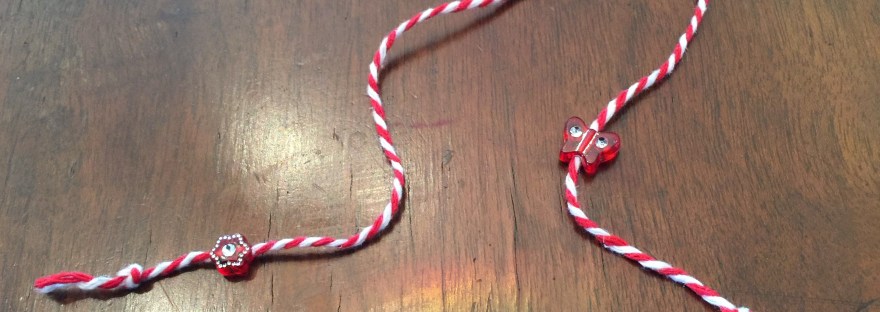
The “Marti” (the Greek word for the month of March is Μαρτιοσ) weaves red and white string together and may have an evil eye charm or other bling on it. Red is for life and passion; white is for purity.  The bracelet is to be worn from the first of March until you see the first birds returning from migration or the first blossoming tree, all celebrating the arrival of Spring.  This is a custom that dates back to ancient times.

How you say goodbye to the bracelet at the end of March varies. Some people hang them in fruit trees, so the trees remain healthy and bear lots of fruit.  Some people hang them in trees so the swallows can use the thread for their nests.

Tradition dictates that the bracelets be given as gifts; their powers work better this way.

Demetri and I saw a cherry tree in bloom in the chic downtown Kolonaki neighborhood yesterday.  But we are still going to wear our bracelets until the end of the month.

Καλο Μηνα!

Greek life

Clean Monday

Today is Clean Monday.  It marks the end of Carnival and the beginning of Lent in the Greek Orthodox Church.  It’s a ‘roaming’ holiday that falls on the 7th Monday before Pascha (Greek Easter), which this year is April 15.  For western Christianity, Easter is April 1.  It’s complicated why the two Easters fall on different days, but there are two basic reasons:

  • The Orthodox Church follows the Julian calendar and the Catholic and Protestant churches follow the Gregorian calendar. There is a 13 day difference between the two calendars.
  • The Orthodox Church adheres to the early Christian Church practices (First Ecumenical Council in 325) that require Easter fall after Passover in order to uphold the sequence in the Bible of the passion and death of Christ. Western churches do not always observe this so western Easter could fall before or during Passover.

Clean Monday is about ditching sin and non-fasting foods. The Sunday prior there are special church services in the name of forgiveness, so everyone can begin Lent with a clean conscience.  It’s customary to go to confession this week and to clean the house thoroughly.

Eating meat, eggs and dairy is forbidden to Orthodox Christians throughout the entire Lenten period.  Shellfish is permitted because it doesn’t have blood.  Traditional foods for today include taramosalata, a delicious, salty fish roe spread, gigantes, maroulosalata, a lettuce salad with simple vinaigrette, grilled octopus, boiled shrimp, calamari, and a bread called  lagana –pictured above — a oval-shaped flatbread covered in sesame seeds. You serve all this with ouzo and finish with halva – a candy of sorts made from tahini and sesame seeds; it comes from the arabic word for ‘sweet.’

The fun part of Clean Monday is that it’s a national holiday that celebrates the beginning of Spring.  The tradition goes back to ancient times when Greeks would celebrate the seasons’ change with worship and festivals dedicated to Dionysos, the god of wine and feasts.  It’s customary to fly kites.  So we did.  Papou bought kites last week for Valentine’s Day (boy are we mixing the US traditions with Greek ones) for Michael, Peter, Giorgos and Little Katerina.  Big Katerina came over this afternoon and we all went down to the beach and worked on our kite flying skills.  The wind was etsi-ketsi (so-so).  We’d get the kites airborne and sometimes they’d swoop right back down.  But it was fun and there were tons of people doing the same thing all along the Voula beaches.

The weekend has been beautiful. Saturday and Sunday were sunny; today is cloudy but not cold. We spent time Saturday in a great park in Glyfada riding scooters, ziplining, climbing and kicking a soccer ball.  Sunday we hung out in the square for the Apokries carnival where most kids were in costume.  Signs of summer re-emerged yesterday with the square full of bikes and scooters and tons of people.


Greek life

Apokries

“Apokries” is essentially Carnival; the three-week celebration that leads up to Lent, the 40 days before Easter.  Literally, apokries (αποκριεσ) means “no more meat,” indicating the approaching Lenten fast. There are some significant days during this three week party — including “Tsiknopempti” or burnt Thursday, which is a last hurrah day for grilling and eating all kinds of meat before the Lenten fast begins.   There’s also apparently a cheese Thursday, but I sadly missed it. It was yesterday.

Apokries in modern times is mostly associated with the orthodox faith and the preparation for Easter, but the origins come from ancient traditions at this time of year that celebrated the end of winter and the coming of Spring — a big part of which was the worship of Dionysos, the God of wine and feast.

We had an awesome pre-tsiknopempti meat celebration of sorts last Saturday with Anna, Vasillis, Giorgos and Katerina.  We went to a taverna on Mount Parnitha, one of the three big mountains that surround Athens on the Attica peninsula. In ancient times, Parnitha was home to a bunch of fortresses for the Athenians to defend themselves from invaders.  In Byzantine times, several monasteries were built.  Tatoi Palace, the 19th century summer palace for the royal family, sits near the bottom, but it’s been abandoned for many years.  Today, much of the mountain land is a preserve for various animals and some 1,000 species of plants grow here.  The taverna was terrific and it was packed with families, couples, and motorcyclists heading up or down the mountain.  Some kids had costumes and masks. We had a great table by the window, feasted on chicken, pork steaks, braised pork, potatoes, tzaziki and panzaria (beets).   We looked at their excellent NYC Christmas pictures and watched the fog roll in to Athens. We left the taverna, played in a park, and had a coffee in Varibobi and then drove into Athens for Mina’s name day party that she and Theodoris were hosting at their house.  We were the first to leave at 11:30 pm.  It was so nice to meet their friends who  we’ve heard about and the whole party was lovely.  The food there was terrific too – lots of homemade dishes from Mina’s mom, plus pizzas, really good wine, champagne and the most beautiful cake ever.

This weekend is the ‘big’ weekend for Carnival festivals and parties.  Each neighborhood in Athens has its own celebration: parades, street parties and the like. Plaka does something different than Psirri which is different than what Metaxourgeio does.  In Voula on Sunday, there will be a little party in the Voula plateia, with games and mask making tables and also some kite-making supplies to prepare for Clean Monday.

Feeling slightly gypped out of Halloween in October, Peter and Michael are elated to make up for it this week.  A friend of Michael’s had a costume birthday party last Sunday.  They were all a sweaty mess after running (and running and running) around in their polyester, non-wicking costumes.  But man did they have a blast.  And today, the school asks that no backpacks come, only kids in costume ready to party.  They are both Star Wars characters of course, and they hopped on the bus with money in their pockets for the souvlaki that will come to school around 11:30.

Funny enough, if you type αποκριεσ into Google translate, it comes back as ‘Halloween.’

These last couple of weeks we had our first Kessaris basketball game, did some indoor climbing, worked on fun art projects, tried on many costumes and made Valentine cookies for Papou and Sandy, our neighbors, teachers and school bus drivers. I didn’t have a rolling pin or a mixer so decided to make valentine shaped M&M cookies. And yes, cookie scraps with heart angles are just as delicious as full cookies.

Demetri headed off to Korea today for the second half of the Olympics.  He’s got a long flight ahead – Athens/London/Seoul, but having tickets for women’s downhill should be worth the trip.


Greek life

Lemonia!

Oh sure, the subject line of this post sounds like the bigger, badder bully cousin of the lung infection we all dread.

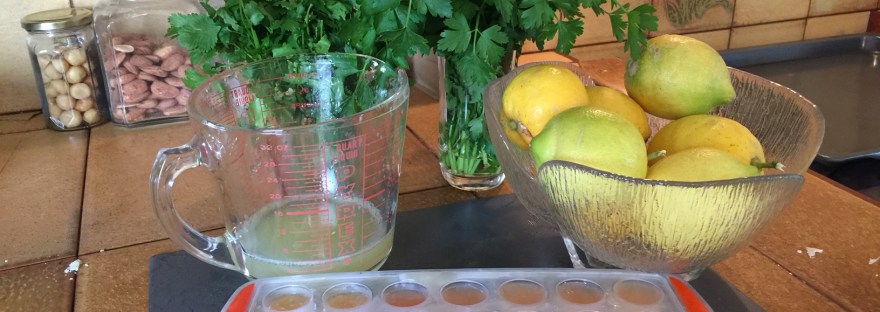
In fact, it’s what is growing on the trees outside of our building. (Singular: lemoni; plural: lemonia). Today I picked so many that I froze two ice cube trays with freshly squeezed juice and still have 2/3 cup of juice and 7 whole lemons left. (See photo above of our kitchen counter).

Winter here is nice for many reasons. This is a big one.

And PS, they smell best at the moment you snap them from the tree.