Greek life

Guys’ day out

At the end of Tyler’s visit, he, Papou and Demetri spent a day downtown. Athens is empty  — the entire city is on vacation, so many stores are closed and parking is an absolute dream.

First, a visit to the Panathenaic Stadium, used for the first time in about 330 BC and the site of the revival of the Olympic games in 1896. It’s also the place, where every four years, the Olympic flame begins its journey to both winter and summer games.

Next stop, the National Archaeological Museum, with some 11,000 prehistory to late antiquity exhibits. The building itself is lovely, too. The photo above is bronze statue from the Hellenistic period; it was found on the island of Evia around 140 BC.

Then they wandered over to the neighborhood where Papou grew up and saw the house he lived in with his parents and 2 sisters. An excavation has been going on for many years where the house was.  Some relics/antiques have been found, but it can take the Greek state many years to determine what they are.  It’s a law that they do so with any excavation.  You can imagine the jokes and giggles about Papou’s house being an archaeological dig. “You’re so old that ….”

Then they saw the shop where the family bakery used to be. It’s now an apartment building, but in the 40s and 50s, it was a neighborhood bakery. Often, neighbors brought things to the Fefes bakery to cook in their large oven. It was a very common community practice & might still be. During the occupation, Nazi soldiers were in an out of the bakery and always in the streets, never kind to the Greek people.  One day, as Papou was running home from the bakery, he literally ran into a solider, who was irritated enough to knock him down in retaliation.  Papou couldn’t have been older than Michael when this happened and like any little boy would be, he was afraid.

Needing snacks, they stopped for bougatsa, which is phyllo dough wrapped around a filling.  I believe the most common are a sweet cheese filling with cinnamon and powdered sugar on top, served hot.  There are also savory fillings like chicken and ham. This particular bougatsa cafe is in a lovely shaded spot surrounded by trees and bougainvillea.  We visited last summer.

We ended the day together, at a fish tavern on the sea south of Voula, with special guest star Andreas, Demetri’s first cousin.

Tyler departed yesterday, the 17th.  We swam, catching crabs and urchins and trying for fish with our nets, and then filled his belly with souvlaki before he headed back to the US.


Greek life, Travels

Rhodes, part 2

Rhodes has beautiful beaches; we visited three during our stay: Tsampikas, Traganou and Anthony Quinn. Quinn filmed “Guns of Navaronne” in Rhodes and loved Greece very much. (“Zorba the Greek” was filmed on the island of Crete).  He wanted to buy three parcels of land right above the cove of the beach that now bears his name; the middle one was owned by the state and they promised to sell it to him.  They reneged, despite the fact that Quinn had already paid for significant water and power infrastructure to the area.  The beach is gorgeous; easy to see why he chose here.  Tsampikas and Traganou were large, organized beaches (chairs, umbrellas, snack bar) and both had nifty rocks for jumping and caves for exploring.  We had the SUPs with us and we took turns paddling around.

With six mild sunburns (everyone except Michael), we spent a day out of the sun to explore. We started our day at the Butterfly (petaloudes) Valley, a preserve for tiger moths.  It was a pretty, shaded hike along a river with millions of orange and black tiger moths camouflaging themselves on rocks and tree trunks. The forest is full of oriental sweet gum trees (Demetri’s landscape & hort degree is so handy) which the butterflies (moths) love.

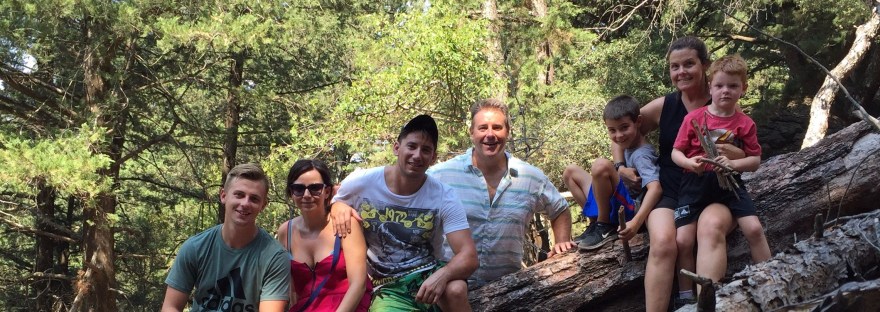
From there we drove to Profitis Ilias (Prophet Elijah), a mountain with sea views about 26 km from Rhodes town. There is a beautiful chalet at the top surrounded by forest that is home to the rare “dama dama” deer. The chalet building was constructed in 1929 by Italian colonists, commandeered by the Nazis during WWII and used as a hospital for German soldiers, and now it’s a hotel. There’s also a villa onsite that was the summer residence of the Italian Governor of Rhodes from 1936-40.  This was intended as a retirement home for Benito Mussolini; the photo of us on this page is just below the villa. Obviously Mussolini never retired here. We had a lovely lunch in the hotel (which had a huge bookshelf full of kids’ toys, bless them) and headed to Lindos.

Lindos was founded by the Dorians in the 10th century B.C.  It’s a pretty little village with a large acropolis at the top.  We arrived at 6:45 and had an hour to see it – we literally jogged through the alleys and up the hill to get in before closing time and sunset.  It was hot and very humid; we were grateful for breezes at the top.  There was considerable ancient wealth here – the archaeological museum has some wonderful pieces found in and around the Lindos acropolis. The Dorians built a temple to Athena Lindia in the 4th century on top of another destroyed temple, a Hellenistic Wall surrounds the Acropolis, and there is a Roman temple dedicated to Emperor Diocletian. All of these are protected by a castle built by the Knights of St. John in the 1300s.  Outside the walls are the remains of an ancient theater.

Side note: we logged some 16,000 steps (6.5 miles) on this exploration day — and this included a few hours of driving.

On our last night in Rhodes, we visited a very traditional taverna in Psinthos — most of the dishes (goat in tomato sauce with chickpeas, lamb with lemon, oven cooked pork) had been cooking for hours.  We decided to go early, arriving around 8 pm which turned out to be a smart move as by 845 the restaurant was completely full.  We ended the evening as we have most of the summer — kids asleep at horrible angles in the backseat, carrying them into bed at midnight (or later).


Greek life, Travels

Rhodes, part 1

Most of Europe takes holiday in August – and the beaches and islands of Greece are a popular destination. Demetri’s been interested in Rhodes (Rodos in Greek) for many reasons, so our August holiday is a week here.  We rented a lovely house in the village of Koskinou with a swimming pool and room for 8 of us – Papou, Theodoris and Mina and us five.

Rhodes is the capital of and largest island in the Dodecanse islands.  It’s less than 10 km from Turkey, in fact on clear days we could see the Turkish coast from our kitchen. The first settlers look to have arrived in 500 BC; Rhodes became a strong power in the years to follow.  The Colossus of Rhodes, one of the seven wonders of the ancient world, was constructed in the harbor of Rhodes town.

The island was under Roman rule for 300 years starting in 70 A.D., and then occupied by Venetians and Turks. It was controlled by Italy until 1947 when it was transferred to Greece.  There’s a great deal of Italian influence here – architecture, food, leather, residents, gelato …. we had some lovely dinners inside the old city in the taverna gardens.

The town of Rhodes has an amazing walled old city fortified by the Knights of Saint John in 1309. Their initial role was to care for wounded and ailing crusaders, and they built a large hospital.  The Knights represented all of the major European catholic countries – a total of 8 ‘houses’ — and they restored and built about 30 castles on the island.  The old city was the main fortress; during foreign attacks each group of Knights was assigned to defend certain sections.  The large moat is now a public park.  Rhodes was finally captured by the Turks in 1522, but because the Knights had fought so valiantly, they were given safe passage out (significant —  this is not the way the Ottoman Empire rolled).  Thousands of Rhodians departed with them; many settled in Crete which is southeast of Rhodes.  The Knights themselves found a new home in Malta.

The Palace of Grand Masters, built in the 14th century by the Knights, has 150+ rooms. 24 are open to the public now & they’re filled with mosaics, multicolored marble, frescoes, beautiful tile and antique furniture from the 16th century (Peter called one collection of tall seats the “knight cubbies”).  Because the Italians occupied and controlled Rhodes until after WWII, they were the ones who restored the castle in the early 20th century.  The Palace served as holiday residence for King Victor Emmanuel III and Benito Mussolini.  There’s a grand plaque in the front hall honoring both men … and Fascism. It has a beautiful inner courtyard full of statues from the Greek and Roman periods.  Today, the Palace and the fabulous archaeological museum around the corner belong to the Greek state.

Walking through this old city is amazingly cool.  The streets are cobblestone, the sidewalks are full of mosaics and there are fountains and springs for a quick drink or a splash on the face.

Greek life

Tyler arrives

Tyler arrived August 6.  He’s the highlight of the boys’ summer – the anticipation of his visit has been SO big. He left Denver mid-May to spend the summer at home in NY where he had a great job with a construction company where he got internship credits toward his civil engineering degree.  He came to Greece for his last 12 days of summer before he returns to Denver for his third year at MSU.  He’ll be in university housing (apartments) across from the convention center downtown.  Michael and Peter could barely (ok, couldn’t) contain themselves standing outside of the baggage claim doors.  Tyler walked through and scooped them up in one effortless motion and I thought they were going to strangle him they were hugging so hard.

We spent his first night in Greece in the Voula square – his first meal request was Kontosouvli, basically a tender, grilled pork with herbs and served with (of course) French fries. One of the psistarias in the square, Masati, does this dish very well, and they even have a chicken version.

After a proper night’s sleep, we took ourselves and Katerina to swim Monday afternoon.  It’s been unusually hot for August – 40ish – so the water is absolutely the best place to be. August 7 marked the full moon – this month, the moon is the closest to earth that it gets all year, so much of Greece turns this night into a party.  From Marathon to Plaka, there are full moon celebrations and parties.  In Monasteraki and Plaka and Theseion, the old parts of Athens, many antiquities were open late and free to the public.  Thodoris met us and we ate street food on the go and had a great walk through Athens.  Papou showed us his boy scout club building which was right across from the Theater of Herodeus Atticus on the Acropolis. We arrived home at midnight; 845 flight Tuesday to Rhodes. Can’t seem to get to bed early no matter what.


Greek life

A word about housekeeping

Greek women keep a very fastidious home.  They cook every day and when they aren’t cooking, they are going to the markets — butcher, produce, fourno (bakeries), zaxaroplastio (pastry shops). They beat rugs.  They iron clean laundry down to underwear, towels and sheets.  (No clothes dryers, remember?)  And their cleaning should win medals.

My cleaning skills are fine.  Good even, especially when someone important or discerning is visiting. I subscribe to the philosophy that you must have a party at least quarterly because it really makes you clean out and scrub stuff.  (Sadly, I don’t have quarterly parties).  I have toothbrushes for grout, a really good vacuum for floors, swiffers, disinfecting wipes, rags for scrubbing floors on my hands and knees, microfiber dust cloths.  I clean the bathrooms weekly or more.  (There are 4 boys in my house; ‘ nuf said).  I learned from Allison to clean myself into the shower.  But I’m also on the lazy side, so I don’t exactly clean myself into the shower every day.  I triage cleaning. Or I hire it out.

Voula is a breezy place.  The Sirocco winds (hot; from Africa) and the Meltemi winds (cooler, from the north-ish)  make it downright windy.  There is a lot of sand, dirt, Bougainvillea leaves and concrete particles flying around.  Greeks also prefer fresh air to air conditioning, even up to say 39 degrees celsius, so veranda doors are usually open all the way.  Our apartment has four beautiful verandas, views of the sea from all of them, and marble floors.  And with no screen doors (rare), they get dirty fast.  Daily mopping is pretty much mandatory.

I didn’t believe this.  But after washing our feet 4 times a day and crunching on stuff walking through the living room, I realized that my ‘fine’ cleaning skills are woefully inadequate.  I vaccuum & sweep everything, and then I start mopping.  It took me about five days to get a sweep/mop/rinse procedure down.  I think I’ve gotten faster…? And I think we’re washing feet only before bed.  Or maybe they’re just not telling me.  But it sure smells good in here.  I hope I can import the super smelling “Pronto” into the States when we return.

Off to the produce stand …