Greek life, Travels

Pelopponesian road trip 2

Since Oxi Day is a national holiday, we took advantage of the three day weekend to road trip around our favorite area of Greece — the Peloponnese. In our summer visit, we spent time in the northeast section (Korfos, Epidavros, Portocheli).   In 2014, we spent almost a week in the southwest corner (Pylos, Kalamata, Stoupa, Vivari, Nafplio).  This time, we focused on the south-central and southeast parts — the two ‘middle fingers’ of the peninsula. Demetri, Papou and I picked the kids up at Μπασκετ (basketball) after school, car packed, snacks ready, music cued.  To get to the Pelopponese, you must cross the Corinth canal — which is really cool no matter if you are watching from the bridge above, or the lowlands on either end, which we did this time. We waited for a cruise ship come through right next to us – you can see it on the right side of the photo of Peter in the Oxi Day post.

Our destination was Monemvasia,  a castle town that everyone we know who has visited absolutely loves.  One of my mom friends said it’s the most romantic place in Greece – and not to worry it’s even more romantic in the rain.  We had blue skies all weekend and it is indeed spectacular. The town is carved out of the back of a huge rock that sits in the sea.  In Medieval times, locals avoided attacks because the city wasn’t visible from the mainland; the only way to reach it then was by boat.  Now, there’s a causeway paved from the mainland to the rock, which is how the city got its name: Monemvasia means ‘single entrance.’ It’s been occupied by nearly everyone — Arabs, Normans, Turks, Venetians — so it wasn’t successful in staying entirely hidden.

There is a walled city at the bottom and the remains of a medieval city at the top. Views are spectacular no matter where you are.  We loved hiking up and around the old city and we stopped for coffee at a cafe that faces the sea while the boys played and hiked in a little protected area.

We then drove to the quiet, little island of Elafonisos, which is said to have some of the best beaches in Greece.  Papou and Sandy spent a weekend there in May.  We knew that most of the island would be closed for the season, but we took the 15 minute ferry ride anyway and watched the boys ninja warrior themselves across and over rocks at the shore.  We got back on the last ferry of the day and got back in the car.

The next couple of hours we were diverted by car trouble.  Earlier that day, a warning light came on telling us to add antifreeze.  We stopped to do that, and somehow, the radiator cap didn’t get tightened. About five kilometers later, we heard a clunk, and that was the end of the cap.  After Elafonisos, we stopped a gas station where one of the mechanics fashioned a cap for us.   Then, close to the top of the mountain pass we were climbing, a red light came on telling us to stop the car.  The new temporary cap was gone.  Demetri and Papou turned the heat on, put some water in the radiator, and we coasted down the other side of the mountain in complete silence.  We went back to the service station where they had put the original top off in there and 4 mechanics inspected the car. They had no caps we could purchase, so we figured we’d call the Greek equivalent of AAA the following day.  We bought a lot of antifreeze and slowly drove back to Monemvasia, and had dinner in a grill house and played at a park.  We got back to our hotel, the kids got ready for bed and Demetri went back out to the car and found BOTH caps on the skid plate.  Road trip back on!

Saturday, we drove south and west and south again around the coast and into the Mani peninsula. Mani’s terrain is rugged with rocky mountains and lots of olive trees. We stopped for lunch at a fish tavern in the harbor town of Gerolimenas. We ate lots of local fish paired with nice, cold ouzo and sat next to the water watching the black rain clouds.

Maniots are thought to descend from the ancient Dorian civilization and their reputation is tough, fierce, independent. The most common housing in Mani was a fortified village made of house towers where they could defend themselves from invaders.  There are a view of these villages that still exist; after lunch we drove to one called Vathia, which is one of the best preserved towns.  Most of the homes have been abandoned, though there was one that had a courtyard with pretty well maintained plants and new doors with screens. We walked up, through and around the dirt paths imagining what it would be like to live here. We stopped in the large-ish town of Gytheo on the way back, walked in the harbor and played foosball and air hockey on the patio of a tavern.

Sunday, we took a coastal route back north, stopping to see a huge shipwreck called the Demetrios. Next was another harbor town for a coffee. Peter was ninja warrioring and fell in the water but it wasn’t deep.  Then we made our way to a very cool village called Leonidio where we watched climbers scale these long, vertical rocks.  We had Sunday lunch in a taverna facing the water — roasted chicken in lemon sauce, roasted goat in lemon sauce, imam (roasted eggplant with tomatoes and onions) and more ouzo.  We headed back to Athens through mountain towns, and found a beach town that we’ll come back to in the Spring or Summer where the water is crystal clear.

There is so much to see in this pretty region of Greece and it’s full of cities that we all learned about in history class: Tripoli, Sparta, Olympia, Myceanae, Thermopylae.  I can see Mrs. Miles’ handwriting covering the entire blackboard with the day’s lecture in 10th grade ancient and medieval history class.  The coastal towns are all pristine and adorable and the swimming is some of the best in the world. We scoped a few places to return to this spring when it’s beach time again.

Our next Pelopponesian stop will be Kalavryta, home of some of the Fefes family.
 

Greek life

The 2018 Olympics are underway!

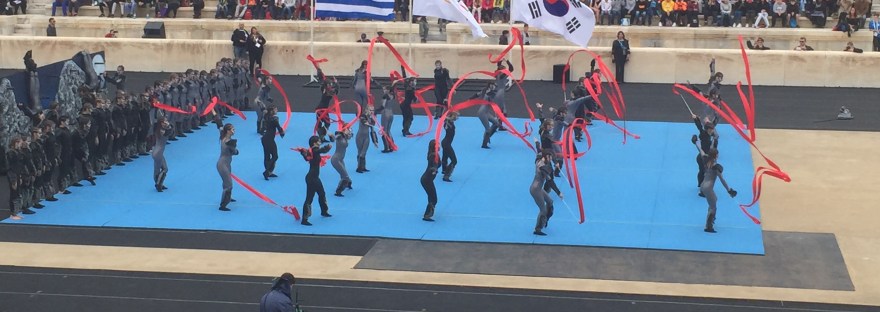
On October 24, the torch for the 2018 winter games was lit in the city of Olympia and began its week long journey across Greece.  505 different torchbearers ran the relay with 20+ welcoming ceremonies in different cities around the country.  Monday, the torch arrived at the Acropolis, and yesterday, the final hand off ceremony was held in downtown Athens at the Panathenaic Stadium, the site of the first modern Olympic games in 1896.

The torch relay spreads a message of friendship, solidarity and peace around the world.  Yesterday’s ceremony began with a dance routine from the Greek gymnastics team Olympiada Thakomakedonon. Then, Korean dancers and singers performed, followed by the Greek presidential guard raising the Olympic, Greek and South Korean flags, and finally a youth choir sang the national anthems of Greece and South Korea.  At that point, the flame entered the stadium, carried by a South Korean gold medalist speed skater.  He handed it to a Greek olympic skier who lapped it around the stadium before lighting the cauldron.  Greek and South Korean dignitaries both spoke — in Greek, English and Korean — about the honor the games brings to the world and to their countries.

The ceremony was not very crowded, but it was certainly international.  Around me I heard French, Korean, Italian, English and Greek.  A few school groups were there in uniform and waving Greek flags.  There were also a lot of Korean folks there, waving flags and cheering loudly.  It was 90 minutes of pure joy and I had tears in my eyes more than once.

After the ceremony, Demetri made his way down to meet the Greek American runner, Dean Karnazes, who was one of the torch bearers and another Greek athlete.  (Go to Demetri’s facebook page to see his photos and videos — he had the ‘real’ camera and they’re great!)

The flame lands in South Korea today to begin its 100-day journey to PyeongChang.


Greek life

Oxi Day 

On this day in 1940, Italy sent an ultimatum in the middle of the night to Greece: allow Italian forces to occupy strategic locations in Greece or otherwise face war. Italy gave Greece a couple of hours to respond. Greek Prime Minister Ioannis Metaxas officially responded, ” then, it is war,” but his sentiment, and that of Greeks nationwide was “Oxi,” no. (Say OH-hee). Before the ultimatum expired, Italian troops attacked Greece via the Albanian border.  On the morning of  October 28, Greeks of all political beliefs took to the streets shouting “Oxi! Oxi!” and this resistance became both the National cause and the beginning of the Greco-Italian War.

Italian troops were met with fierce Greek fighting, which surprised Mussolini as Metaxas was also a fascist; Mussolini likely assumed ideology would be on his side.  The initial invasion was a bit of a disaster — Italian troops were ill prepared for the rough Greek terrain at the northern border, and by mid-November the Greeks had stopped the Italians and pushed them back into Albania.  British forces joined and fought alongside Greece, and Mussolini was forced to ask for Hitler’s help. The Italian defeat and the Greek counter-offensive of 1940 have been called the “first Axis setback of the entire war” by several historians.  Hitler’s Greek distraction forced him to delay Nazi plans to invade Russia which many say changed the course of the war. The Greco-Italian war lasted six months. The Greeks surrendered late that winter, Athens fell April 20, 1941, Crete in May, and the Nazis occupied Greece until October 1944.

As of 1942, October 28 has been celebrated as a national holiday; it is one of the most important still today. This week, Greek flags appeared all over Athens, and school children nationwide learned the importance of saying no while practicing songs, poems, drums and marching for ceremonies at the end of the week.

Demetri, Papou and I went to the 1st-3rd grade celebration at our school. There were videos with news clips from 1940 showing soldiers in waist deep snow, citizen parades, malnourished children during the war. Teams of kids from each grade recited poems, a choir sang various national songs and other songs were played via video. There was a fun, peppy, famous Italian song (Campagnola Bella) where the words were changed to “foolish Mussolini,” and much to my surprise and delight, they sang “We are the World” in Greek! The whole room sang along.

Friday was the school holiday so we took a road trip  (more on that next post), and today we will wander the south Pelopponese in search of Oxi celebrations.

Greek life

Greek name days

Greek Orthodoxy dedicates nearly every day of the year to a Saint or Martyr.   When someone is named after one of those saints, that day becomes their “name day” and is celebrated like a birthday —  “Chronia Polla” is the greeting for both happy birthday and happy name day.  It literally translates to ‘many years.’  There are some 3800 first names in Greece that correspond to a name day.

Greece separates church and state on a technicality, and though there are citizens who aren’t Greek Orthodox, they are definitely a small minority. Some name days are national holidays. August 15, the feast of the Ascension in both Greek Orthodoxy and Roman Catholicism, is a b-i-g one. “Panagia” means ‘all holy’ and is one of the names given to Mary, the mother of Christ.  So, anyone with a derivative of this name celebrates August 15 as their name day.  Both Peter and Papou are named Panagiotis. At churches named for Panagia, there are celebrations all day.

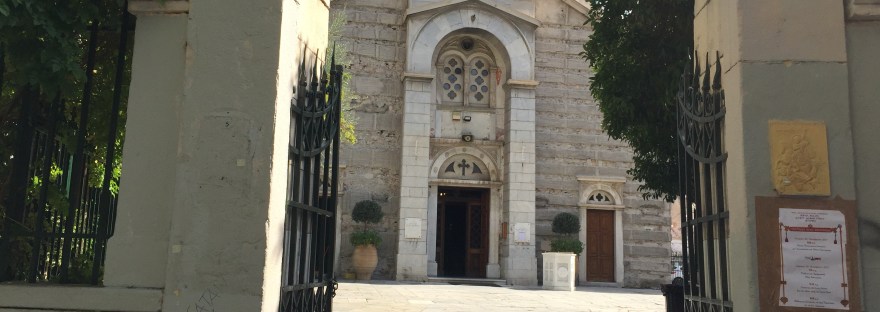
October 26 (this week), is St. Demetrios day. Demetrios was a 4th Century military saint; he’s quite revered. He comes from Thessaloniki, and there’s a large church there where his remains were found. St. Demetrios is also the protector of the pretty Athens suburb of Psychiko, so that area has a holiday of sorts this week, too – i.e., no school on the 26th. James, the English version of Demetrios, is celebrated this day also. The photo in this post is St. Demetrios church in Psirri, an old Athens neighborhood.

St. Mixalis Day is November 8.  Mixalis (Michael) was an archangel (who’s thinking of John Travolta yelling “BATTLE!”?) who led the Jews out of Egypt; he also announced to Abraham that he had to sacrifice his son and he’s the patron saint of paratroopers. November 8 is a day for all angels and archangels, so think Gabriel, Angelos, Angeliki too.

It’s coincidence, but kinda cool, that both Michael’s and Peter’s name days are just a few days before their real birthdays. Peter got name day gifts, even. Papou gave Demetri a beautiful set of binoculars as an early name day gift; now he can see details on the passing ships!

Tyler doesn’t have a name day per se, as there is no Saint Tyler in Orthodoxy.  In his case, he celebrates on November 1, All Saints Day.

My name day is December 25, for obvious reasons.

The majority of name days are the same date every year, but there are a few “floaters” that are determined by the start of Lent and when Easter falls. Interested in your name day?  The Church of Greece maintains a database where you can look it up.


Greek life, Travels

Molon lave

Greece is full of villages.  Essentially a village is a small town or a small section of a larger town, but ‘village’ evokes a different picture in my mind: authentic, untouched, pure.  Seaside villages, like the towns on the Greek islands, typically rely on tourism and may center around a port.  Mountain villages have few inhabitants; those who live there make their living in agriculture.

This last weekend, we spent time in and around Mina’s village in Central Greece, about 2.5 hours north of Voula. Her mother’s family is from this area and her parents, and some aunts/uncles and cousins have homes both here and in Athens.  We left Saturday morning.  We arrived, changed into bathing suits and thought we’d spend an hour or two at the beach just south of Kamena Vourla while the sun was strong.  Instead, we spent the next 4-5 hours taking turns on the paddleboard, swimming and chilling on the deserted beach.  The water was cold and the sun felt great.  We had dinner that night on the way home in Kamena Vourla. The next morning, Mina made a lovely breakfast, and Theodoris and Demetri picked a bunch of pomegranates from the trees.  We packed up and headed out.  Our first stop was Thermopylae, which translates to ‘hot gate’ because of the many thermal springs in the area.  Greek mythology says Thermopylae was the entrance to Hades.  There’s also a story that Hercules jumped into the river in an attempt to wash off the poison that was in his cloak’s lining — a curse put there by the centaur who fell in love with Hercules’ wife — and the river became hot and has stayed hot ever since.

Thermopylae is primarily known for the epic battle in 480 BC in which a very outnumbered Greek army of 5000 led by Leonidas of Sparta fought a 150,000 strong army of Persians, led by Xerxes. (You know, 300?).  Xerxes told Leonidas and his army to lay down their weapons; Leonidas responded, ‘molon lave,’ which translates from ancient Greek to ‘come take them if you dare.’  The Greeks held the Persians off for three days before they were betrayed by Ephialtes, who told Xerxes about a back way to get around the mountain and behind the Greek lines. Interestingly, the modern Greek word for ‘nightmare’ is efialtes – this was a way to shame his name. The Greeks lost, but not before they managed to kill 30,000 Persians.  Thermopylae was a moral victory, and years later the Greeks finally defeated the Persians. There’s a cool monument and statue of Leonidas at the battle site.  We bought some honey from a local artisan selling it from her car and hiked up to the hot springs.  The Sulphur gives the water a greenish-white color. Surrounded by plants and grasses that are turning colors, it was sure a pretty view.

From there, we headed to the mountain village of Pavliani.  Theodoris has explored every inch of Greece and knows so much about its ancient and modern history and knows all the best beaches, villages, hiking trails, islands and restaurants. I want to see all of Greece with him.  Pavliani is a typical mountain village – small stone houses, pretty little yards and a taverna or three.  Across the road from the village, though, is the most awesome hiking path that stretches for 9 kilometers along a river.  The whole thing is a giant playground.  There are swings hanging from huge trees, a bridge that looks like piano keys, an old metal cable with seats that serves as a zip line, a trampoline, a tree house, a human foosball court, a ‘gym’ with broken weight benches and chair soccer, forest bowling, and a little area with wooden picnic tables and lounges.  Every 100 meters there’s a new thing to play on.  It is absolutely brilliant. People of all ages were hiking and playing and at the bottom there was a group of old and young having a dance party.  I think our little group hummed the Macarena at least halfway up the path after watching them.  We came down around 6 to rest and eat in one of the village tavernas.  This village is the most ‘fun’ place I’ve seen in Greece.  It has adorable artwork not just along the hiking path, but on the houses, garages and garbage bins in the village town itself.  It was a great weekend.  We drove home through some other mountain towns before picking up the national road to head back to Voula, carrying sleeping kiddos to bed.